
Man Ray - In Paris
CCBB Institutional Text (Sorry, this content only exists in Portuguese)
Man Ray

Curatorial Text (Sorry, this content only exists in Portuguese)
Man Ray

Dadá (Sorry, this content only exists in Portuguese)
Man Ray

Marcel Duchamp, Subscription Bonus for the Monte Carlo Roulette
Man Ray


Vintage gelatin-silver print 18 x 12 cm Vintage gelatin-silver prints, original contacts 8 x 5 cm ©Man Ray 2015 Trust Marcel Duchamp, Subscription Bonus for the Monte Carlo Roulette 1924 Vintage gelatin-silver print 18 x 12 cm Vintage gelatin-silver prints, original contacts 8 x 5 cm Marcel Duchamp liked to disguise himself, as shown by a number of images made by Man Ray: Tonsure, in 1919, Belle Haleine, Eau de Voilette and Rrose Sélavy “Eros, this is life”], in 1921. In 1924, Marcel Duchamp created a subscription bonus for the Monte Carlo roulette. In Self Portrait, Man Ray explains how one of his portraits, naively taken between friends, became the central image of this work. Marcel Duchamp who, on occasion, had stopped painting, wished to probe more deeply “the unknown and mysterious laws of chance and hazard” to master them. “And so he took up roulette […] and worked out a system of placing his money that would infallibly bring in a return profit. But, to put his project into practice, capital was needed. He obtained a loan of about six hundred dollars from various friends, guaranteed by an issue of thirty bonds at twenty dollars, the form of which he designed. [...] in the center of which was a portrait of himself. But this portrait, which I made for him, was taken while his hair and face were in a white lather during a shave and shampoo. Otherwise, the bond looked quite professional” (Self Portrait, p. 235). This child’s play, which consists of shaping the hair in all sorts of forms while being washed, is taken up again by Marcel Duchamp, wishing to disguise himself once more: the horns sculpted in foam lend him the guise of a demon, in the precise moment when the latter would tempt. Simultaneously, he pokes fun at himself and at the others, as, in lieu of money, he gives back something false. By gluing his made-up head on these bonds given to the creditors, Marcel Duchamp “made fun of them”, betting on his...
Dust Breeding / Dust Breeding, detail
Man Ray


Vintage gelatin-silver print, original contact reframed 6 x 9 cm Dust Breeding, detail Gelatin-silver print from the 1940’s 21 x 26,7 cm ©Man Ray 2015 Trust Dust Breeding 1920 Vintage gelatin-silver print, original contact reframed 6 x 9 cm Dust Breeding, detail 1920 Gelatin-silver print from the 1940’s 21 x 26,7 cm Man Ray meets Marcel Duchamp (1887–1968) in New York in 1915. The latter, retired, had arrived shortly before and soon became a member of a young modern artists’ group to which Man Ray belonged, and which gravitated around Alfred Stieglitz and his Little Gallery. Soon after Duchamp’s settling down in the city, he starts The Large Glass, the creation of which lasts for several years. Around October, 1920, he writes his sister Suzanne Croti, saying that Man Ray had just made an “aerial view of the dust breeding”, a result from the accumulation of dirt underneath The Large Glass lying in his studio, and which would be fixed with varnish. Man Ray reports the event, without dating it, in Self Portrait: “I suggested to Duchamp that I pick up my camera, which I had never taken out of my place [...]. As I had already noticed, there was only a single unshaded bulb hanging over his work. [...] with the camera fixed steadily on its tripod and a long exposure, the result would be satisfactory. Looking down on the work as I focused the camera, it appeared like some strange landscape from a bird’s-eye view. There was dust on the work and bits of tissue and cotton wadding that had been used to clean up the finished parts, adding to the mystery” (Boston/Toronto: Little, Brown and Company, 1963, p. 90–1). The photo was published in October 1922, in Littérature, a magazine founded by André Breton and Louis Aragon, with the title: “View taken from high by Man Ray”. And as caption: “This is Rrose Sélavy’s domain. How arid it is. How fertile it is. How happy it is. How sad it is!”. Only later did Marcel Duchamp give the work its definitive title. Photography, an instantaneous form for appropriating reality, becomes the ideal medium for exploring another reality. The feeble lighting which compels Man Ray to open the camera shutter to the most and increase the depth of field, the scale change and the plane oscillation turn what would have been a run-of-the-mill reproduction of a work in its process of elaboration into a strange landscape in which dust and cotton wadding simulate a vast foggy extension, partially hiding traces of an unintelligible architecture.
Coat Stand
Man Ray

Late gelatin-silver print from the 1960’s 25,7 x 16 cm Coat Stand 1920 Late gelatin-silver print from the 1960’s 25,7 x 16 cm There are three different versions for this photograph: the first, on which a white stamp is glued, hiding the woman’s sex, is called Dadaphoto; the second, without the stamp, bears the title Model, and the third, which one sees an alteration of the work caused by the tearing off of the stamp, is dubbed Coat Stand. This image is Man Ray’s first photographic nude. Dadaphoto, however, is viewed as a satirical vision, precisely dada, of the classic nude, in which the pose of this woman-mannequin destroys the esthetic canons. Upon its publication, in 1921, the reproduced image takes a stamp hiding the model’s sex, the modern equivalent of the prude vine leaf. The stamp is absent from the other press runs known, which bring traces of its pulling off on the image. The English title, Coat Stand, implies a word game between the title and the work: coat means “jacket” and stand, “standing up”. However, a coat cannot stand up. The photograph shows the aberration, the illogicality of this composite word, which assigns to an object a nature akin to man’s. And Coat Stand – this is its name – seems to be awaiting a jacket to come to cover her, as, with the stamp torn off, it is not a Dadaphoto any more, but rather a body exposed, bashfully exhibiting its nudity, its vulnerability and, above all, its slit. One cannot, in effect, ignore the sexual connotation of the image, highlighted by the evolution of the work itself. The woman’s sex was hidden, obstructed. It is not marked by the tear. We would have here, then, a new version of The Passage from Virgin to Bride, by Marcel Duchamp.
Man Ray

Conde Étienne de Beaumont
Man Ray

Impressão em gelatina e prata de época 17,7 x 12,5 cm ©Man Ray 2015 Trust Count Étienne de Beaumont c. 1925 Vintage gelatin-silver print 17,7 x 12,5 cm In Self Portrait, Man Ray tells how, at the time he still lived in a hotel, at the end of 1921, he was approached by Marquise Casati, who asked him to make her portrait. The success of such portrait was so great that it triggered a huge number of orders, which compelled Man Ray to install himself in a real studio. It is possible that Count Étienne de Beaumont, after hearing about a photographer who could work “miracles”, had the idea of inviting Man Ray to one of his balls, in order to photograph all his guests. It was probably thanks to Jean Cocteau, a friend of the Count’s since 1914, that Man Ray met one of the most important patrons of modern art, as it was he who sponsored Parade, in 1917, and The Ox on the Roof, in 1920. The Count of Beaumont’s balls were famous for their pomp, and everyone in Paris, as well as all those who dedicated themselves to the art world, met there. The best known of these were certainly the Ball of the Games (February 27th, 1922), the Ball of the Sea (1928), and the Ball of the Famous Paintings (July 1935). This portrait of Count Étienne de Beaumont by Man Ray was twice published in the British edition of Vogue. At the time, Beaumont published in the press another entirely different portrait, made by Baron Meyer, who pictured him standing, wearing a very elegant attire, highlighting his tall stature with a kind of very refined chiaroscuro. This cliché probably corresponded to the image the Count wished to create of himself, as he is depicted in all his splendor, arrogant, aloof, inaccessible. Conversely, Man Ray’s photo renders on him a simpler and more humane image.
Man Ray

Lee Miller
Man Ray

Vintage gelatin-silver print 37,5 x 28,8 cm ©Man Ray 2015 Trust Lee Miller 1929 Vintage gelatin-silver print 37,5 x 28,8 cm “Only sculpture would give account of the beauty of her shapely lips, of her big, pale, and languid eyes, and of her neck, similar to a column”, writes Cecil Beaton in Vogue, in 1960. Introduced to photography by her father, Lee Miller (1907–1977) makes her debut as a model for Vogue in the United States, in 1927. She poses, in particular, for Edward Steichen, prior to departing for Paris, and decides to become a photographer. She becomes not only Man Ray’s assistant, but also his model, and his Egeria from 1929 to 1931. Then, she opens her own fashion photographic studio, working for Patou, Schiaparelli and Chanel. During the Second World War, she works for press and produces, in April, 1945, some of the most memorable images of the Liberation, by General Patton’s troops, of the Dachau and Buchenwald concentration camps. In 1947, she marries Roland Penrose, a British Surrealist painter, and abandons photography.
Man Ray

The Fountain on Place Saint-Sulpice
Man Ray

Vintage gelatin-silver print 29,5 x 23 cm ©Man Ray 2015 Trust The Fountain on Place Saint-Sulpice c. 1936 Vintage gelatin-silver print 29,5 x 23 cm Man Ray resides in Paris for almost fifty years, from 1921 to 1940, and after 1951 to his death in 1976; however, throughout his entire work, only very few images of the city are presented. Some depict emblematic places (such as the Place Saint-Sulpice or the Place de la Concorde) and are noteworthy because of their visual complexity. The framing, nighttime views, everything attempts to avoid the “postcard” effect, enhancing the photographic effect, as well as erases the commonplace, in favor of a new iconography, albeit classic in its construction.
Galets
Man Ray

Gelatin-silver print from the 1980’s 24 x 30 cm ©Man Ray 2015 Trust Galets 1933 Gelatin-silver print from the 1980’s 24 x 30 cm Man Ray demonstrates little interest in photographing nature. What matters to him in this field is the loss of scale which leads to a perception of monumentality; the close-up denatures the photographic object, rendering it apt for digression. Simple pebbles become, by the bias of lenses, mountains into an unreal landscape, true “anamorphic” forms characteristic of Jean Arp. In fact, it is unavoidable to think of the latter’s sculptures which, precisely, materialize in 1933: Concretions are rounded forms, of polished surfaces, which offer to light the favorable facets to fluidity of shadows. Man Ray’s Galets provides a plastic value to organic forms, thereby creating a form of communion with nature. This photograph materializes André Breton’s viewpoint, according to which “surreality would be contained in reality itself”.
Man Ray

Glass Tears
Man Ray


Gelatin-silver print from 1976 18 x 26 cm and 20,5 x 29,5 cm ©Man Ray 2015 Trust Glass Tears 1932 Gelatin-silver print from 1976 18 x 26 cm and 20,5 x 29,5 cm Man Ray produced two images from the same negative, showing in close-up the heavily made up and tearful eyes of women: the first depicted the two eyes (published in Minotaure in 1933); the second contained only one eye, turned to the opposite side (published in Photographie in 1933 and 1934, and in Photographs by Man Ray, Paris 1920–1934). The first was used by one Arlette Bernard, director of two beauty institutes in Paris, who published it in the magazine Fiat, in 1934, to highlight the merits of her new mascara, Cosmecil. In an intelligent manner, Arlette Bernard uses this image of a woman with her eyes enlarged by fascinating eyelashes to sell her product which “wonderfully raises the lashes, does not pinch, nor flows”. The glass thus creates an illusion, and incites “Madame” to “cry at the movies, cry at the theater, laugh to the tears, with no fear of messing her beautiful eyes”. This photograph is a typical example of the change the artist may operate in his image, thanks to the framing. The two studies move from general to particular, showing glass tears artificially glued to model Lydia’s face. To Man Ray, “the eyes not only receive an outward image but give forth an image of an invisible thought”. In this sense, the eye comprises part of Surrealist iconography – we must remember the eye cut by Luis Buñuel is his film The Golden Age. However, this image represents more than this. It is imbued with eroticism. Man Ray evokes, in Self Portrait, the poets who have seen “in a woman’s eyes her sex”. He goes on thus: “[they] have realized that the head contains more orifices than does all of the rest of the body; so many added invitations for poetic, that is, sensual exploration. One may kiss an eye or provoke it to wetness without offending decency”. Further ahead, he states that “it is first through the eyes in the head that the final, the sexual sense is aroused”. Therefore, the different framings of this image are like exploring the woman and her intimacy.
The Pavillion of Elegance
Man Ray

Gelatin-silver print from 1980 30 x 24cm ©Man Ray 2015 Trust The Pavillion of Elegance 1925 Gelatin-silver print from 1980 30 x 24cm Among Man Ray’s first important accomplishments in the fashion field, it is necessary to highlight that which promoted his success and his international reputation: in July, 1925, the Pavillion of Elegance is inaugurated at the International Decorative Art Exhibition. This exhibition was organized by Lucien Vogel, who had asked André Vigneau, connected to the Maison Siegel, to create wood and wax mannequins, “depicting, in each of her preferred positions, the modern woman"". Colored in gold, in silver, in Egyptian red, in gray, pink beige, violet, or pink, according to the fashion’s designer whim, these mannequins were enthusiastically accepted by all the great fashion names for the presentation of their models” (French edition of Vogue, August 1st, 1925). Sent by Vogue to the event, Man Ray shows “the familiar pose of the Parisian woman, seated with crossed legs [...], faithfully repeated by this mannequin dressed in an ocean green Georgette crepe outfit”. These images were published by the three Vogue editions (French, British, and American), as well as on the cover of La Révolution Surréaliste, on July, 15th, 1925. It was exactly the trompe-l’œil of a mannequin identically reproducing the familiar gestures of a woman which pleased the Surrealists. Like the corsets in the shop windows pictured by Eugène Atget, Man Ray photographs here the “Uncanny” of a mannequin to the point of being mistaken for a woman.
Noire et Blanche
Man Ray

Gelatin-silver print from 1984 20 x 25 cm ©Man Ray 2015 Trust Noire et Blanche 1926 Gelatin-silver print from 1984 20 x 25 cm Noire and Blanche presents a black mask and Kiki’s face, both placed on a table, in a stable, balanced and symmetrical composition: the black mask is vertical, where as Kiki’s face is lying on the table which serves them as a support. This photograph appeared for the first time in Vogue, under the title of Nacre Face and Ebony Mask, and was published under the title Noire and Blanche in the magazine Variétés, in July 1928, and later in Art et Décoration, in November. Pierre Migennes describes “the strange poetry emanating from it”: “the same sleep and the same dream, the same mysterious prestige seem to bring close, through time and space, these two feminine masks with closed eyes: one of them, carved in the darkest ebony, no one knows when, by an African sculptor; the other, white, but not candid at all, made up yesterday in Paris”. For Pierre Migennes, Kiki’s face is deliberately close to the shape of a mask: the artist wished to provide a meaning to his work, by way of powerful esthetics. The title itself incites to reflection as, in the same way one reads a text, one reads an image, from left to right. Logic would require, therefore, that the title were “Blanche et Noire”. In 1924, Man Ray published Black and White on the cover of 391, a magazine directed by Francis Picabia. He then juxtaposed two sculptures, one black and the other antique, therefore, two cultures and two arts (photography and sculpture). Noire et Blanche seems to comprise an evolution of this first work: evolution toward life (the stone became flesh), the femininity (Black and White can also be masculine, whereas Noire et Blanche is explicitly feminine), the equality of cultures, the evolution of antique art, represented by the mask (sculpture), toward modern art, represented by Kiki’s flattened face (photography). It seems, thus, that Noire et Blanche is much more than a simple plastic composition. In the least, it illustrates one of Man Ray’s fundamental principles: “fostering reflection”.
Model in Lucien Lelong’s Gown, Seated on Wheelbarrow by Oscar Domínguez
Man Ray

Gelatin-silver print from 1979 25 x 19,5 cm ©Man Ray 2015 Trust Model in Lucien Lelong’s Gown, Seated on Wheelbarrow by Oscar Domínguez 1937 Gelatin-silver print from 1979 25 x 19,5 cm In 1934, bound by contract to Harper’s Bazaar, Man Ray was able to reconcile his personal creativity with commercial restrictions. In the same year, Carmel Snow became Harper's Bazaar chief editor and assigned the magazine’s artistic direction to Alexey Brodovich. Both were interested in assigning a prominent place to photography. The “tricks” which Man Ray wonderfully manipulates and which underlie his quality as “artist” photographer are then acclaimed: solarization, negative inversion, superimposition, mise en abîme and retouching with ink perfectly blend with those for which Brodovich esteems in order to revolutionize Harper’s Bazaar layout. These procedures are numerous. The first of them stems from a revolution in the viewpoint. Opposite to normal vision, that of an adult, which is frontal, one chooses an uncommon viewpoint, that of a “bird”. This emerges as one of the emblematic signs of “photographic modernity”, but is quite rare in Man Ray. We find it, for example, in this work: a wooden wheelbarrow upholstered in leather, a singular object which heralds an artist’s intervention, serves as a seat for a woman with a splendorous gown. The angle of vision is, however, even more original. Far from flattering the image, as one could fear, it not only highlights the model’s relaxation, but also opposes the beauty of Lelong’s silver pleated party gown to the raw matter of Domínguez’s wheelbarrow.
Man Ray

Love Fingers of Man Ray (Rayografh)
Man Ray

Love Fingers of Main Ray’s (sic), the line, the color, the form, the space, the air Rayograph, vintage elatin-silver print, sole piece 17,5 x 12,8 cm ©Man Ray 2015 Trust Love Fingers of Man Ray (Rayografh) Love Fingers of Main Ray’s (sic), the line, the color, the form, the space, the air 1959 Rayograph, vintage elatin-silver print, sole piece 17,5 x 12,8 cm In Self Portrait, Man Ray tells us that, during the winter of 1921, while working in his darkroom, “one sheet of photo paper got into the developing tray – a sheet unexposed that had been mixed with those already exposed under the negatives – [...] regretting the waste of paper, I mechanically placed a small glass funnel, the graduate and the thermometer in the tray on the wetter paper. I turned on the light; before my eyes an image began to form, not quite a simple silhouette of the objects as in a straight photograph, but distorted and refracted by the glass more or less in contact with the paper and standing out against a black background, the part directly exposed to the light”. Man Ray immediately names this “new” procedure “rayograph” and, “setting aside the more serious work”, depletes his stock of “precious paper”, taking everything which was at hand – “my hotel-room key, a handkerchief, some pencils, a brush, a candle, a piece of twine” – to compose images which enjoy him “immensely”, and which promptly arouse success. The procedure is simple and allows for obtaining a single image, without a negative, in which the values of black and white are reversed. Incidentally, he confesses that, when he was a child, placed “fern leaves in a printing frame with proof paper, exposing it to sunlight, and obtaining a white negative of the leaves” Man Ray then conceives the idea of making countertypes of his first essays and produces a luxury album edition with twelve images, named The Delicious Fields. The parallel with automatic writing and The Magnetic Fields (1919), by Breton-Soupault, is evident. These images are akin not to dreams, but to an unknown reality, visible and rendered almost tangible by means of photography. Frequently classified as “the poet who writes with light”, Man Ray is this man “with the head of a magic lantern”, according to André Breton, who makes photography to serve “other purposes than those for which it was created, and in special to pursue, on its own account and commensurate with its own resources, the exploration of this region which painting thought would be able to reserve for itself” (Le Surréalisme et la peinture).
Man Ray

Mannequins at the Surrealist Exhibition
Man Ray


Mannequins by André Masson, Salvador Dalí, Marcel Duchamp, Kurt Seligmann, Oscar Domínguez e Sonia Mossé Vintage gelatin-silver print, original contact 11 x 8 cm ©Man Ray 2015 Trust Mannequins at the Surrealist Exhibition Mannequins by André Masson, Salvador Dalí, Marcel Duchamp, Kurt Seligmann, Oscar Domínguez e Sonia Mossé 1938 Vintage gelatin-silver print, original contact 11 x 8 cm It was by initiative of art critic Raymond Cogniat that the “International Surrealism Exhibition”, orchestrated by André Breton and Paul Éluard, was organized, at a traditional exhibition venue, the Galerie des Beaux-Arts, in January 1938. Marcel Duchamp was, on that occasion, the “curator”, as stated by the exhibition booklet, Man Ray, the “master of light”, and Salvador Dalí and Max Ernst, the “special advisors”. The ceiling of the great exhibition venue was covered by 1,200 coal bags, suspended side by side, and the floor by a carpet of dead leaves. On the opening night, there was no light, with lanterns being distributed to the visitors at the hall entrance. A smell of roasted coffee and hysterical laughter, recorded at an asylum, and played by an invisible phonograph, completed this ambience to say the least strange, “which conjured, as much as possible, that of an art gallery” (André Breton). In the exhibition’s lobby, “Paris’ most beautiful streets” were crowded with girls, most of them dressed in light clothes and exaggerated made up: mannequins made, on the occasion, for the Surrealists, among whom, in particular, Salvador Dalí, André Masson, Marcel Duchamp, Kurt Seligmann, Sonia Mossé and Oscar Domínguez. “These beauties [...] embodied, in a cardboard dream, the eternal feminine. Next to these slender stars, with their shining hair, eyes sheltered by long, curvy and silky lashes, small and well-rounded breasts, enticing hips, in face of their calm lack of prudery, the Surrealist artists, who had had the care of conceiving them, materializing their desire, all felt possessed of the soul of a Pygmalion” (Georges Hugnet, Pleins et déliés. La Chapelle-sur-Loire: Guy Authier, 1972).
Self-Portrait
Man Ray

Vintage gelatin-silver print, original contact, solarization 8,7 x 13,3 cm ©Man Ray 2015 Trust Self-Portrait 1930 Vintage gelatin-silver print, original contact, solarization 8,7 x 13,3 cm Despite the success of his portrait studio, Man Ray adopts, regarding his work, a provoking attitude, even to the point of stating in the magazines of that time that “all here is only the daily nourishment”. The main reason for this artist’s attitude in face of his own work is linked to the fact that the portrait (despite the artistic medium used) was then deemed a minor art. The quest for likeness – a priori inherent to portraits –decreased the artist’s status since the emergence of photography: copying is not making art. With the development of the photographic studios in the 19th century and the democratization of the portrait this brings forth, the portrait genre ceased to be considered by the painters. Consequently, photographers, especially portraitists, were seen as failed painters. Man Ray’s talent in this context entailed making use of techniques which left an imprint on his time and photography, to the extent of bestowing great notoriety onto the portrait genre: superimposition, solarization, and all possible distortion techniques (such as that in this self-portrait) have catalyzed this evolution.
André Breton’s Portrait
Man Ray

Gelatin-silver print from the 1960’s 100 x 70 cm André Breton’s Portrait 1929 Gelatin-silver print from the 1960’s 100 x 70 cm Man Ray, the Surrealism’s official portraitist, is due credit for the most notable portraits of Dalí, Ernst, Giacometti, Tanguy etc., which much contributed to making these artists known. Nevertheless, those of Breton are, doubtlessly, the most numerous and most inspired. André Breton expresses, countless times, his aversion for “the real form of real objects” and, therefore, for the simply objective photography. The will he has to see “books illustrated with photos and not with drawings any more” remains present at all times. It is Man Ray’s and Brassaï’s photographs which are seen on the pages of Mad Love, from 1937. Breton described Man Ray as a “perfect expert of photography and of the lineage of the best painters”, especially because he knew how to go beyond appearances and make photography an instrument of exploration of this region of the soul that “only painting believed being able to reserve for itself”. It is solarization, with its characteristic lining, which bestows Man Ray’s models an extraordinary, almost-unreal aura, as well as brings photography closer to Ingres’ drawing. This technique renders Man Ray’s portrait studio successful in the 1930’s.
Man Ray

Natasha
Man Ray

Gelatin-silver print from the 1980’s 24 x 30 cm ©Man Ray 2015 Trust Natasha 1931 Gelatin-silver print from the 1980’s 24 x 30 cm Lee Miller, in an undated letter addressed to her brother Eric, but probably from 1929, tells that she was working with Man Ray in the darkroom, when the procedure used here, solarization, was discovered. “Something rubbed on my leg [...]. I screamed and turned on the light abruptly. I did not find out what it was, maybe it was a mouse. But I noticed that the film had been exposed. In the development tray, there were a dozen developed negatives on a nude over a black background. Man Ray took them, dipped them in the tray with hyposulphite and looked. The unexposed part of the negative – the black background – had been, under the effect of the lamp light, changed to the edge of the naked and white body”. Besides this brief account, much in Man Ray’s spirit, it should be kept in mind that, according to Lee Miller’s words, Man Ray made this into a device “which he learned to fully master, in order to obtain the effect he wished at each time”. Solarization, a technical effect well-known by the photographers under the name of “Sabatier effect” is technically defined as “the partial inversion of values in a photograph,” accompanied by a characteristic black lining. It can be made during the making of a print in the positive or directly on the negative. Man Ray did it essentially on the negative, which allowed him to later work this image as another, especially when reframing it. The critics did not fail to associate this effect to Ingres’ design, as he gave to the photographic writing one of its features: the line.
Veiled Erotica
Man Ray

Vintage gelatin-silver print, original contact 12 x 9 cm Veiled Erotica 1933 Vintage gelatin-silver print, original contact 12 x 9 cm Born in 1913, in Berlin, Meret Oppenheim lives most of her youth in Switzerland. She arrives in Paris, at age 18, in May 1932, to become an artist. She lives and works at the Odessa hotel, in Montparnasse, until fall 1933. Alberto Giacometti introduces her to Man Ray and to the Surrealist group. In October, 1933, she starts exhibiting with them in Copenhagen, Paris, London and New York, thereby becoming a member in fact of the Surrealist group, and her Breakfast in Fur, from 1936, makes her famous. Meret Oppenheim poses for Man Ray from 1933 to 1936. He makes several portraits of her, but also nudes and, especially, a posing session at Louis Marcoussis’ studio, from which a photograph, Veiled Erotica, was published in Minotaure, in 1934. On this photo session, Meret would later say that, at the time, she was not Man Ray’s model, but his collaborator. However, in a 1979 interview, it does not seem that she had had any participation in Man Ray’s idea of photographing her with her body covered with black ink: “one day, he took her to the studio of Marcoussis, who was an engraver and had a printing press [...]. She does not know whether he had this idea before getting there, or whether he thought so when he saw the printing press and the ink. He said: ‘Place your arm on the ink-covered plate’, and took some pictures of her like that”. In this series, it is interesting to emphasize Man Ray’s will to oppose the Modernist view of that time, which celebrated the age of the machine. The irony is present by means of the erotization of the theme and of the staging revealed through images which function like a photo-novel: Marcoussis, sporting a beard akin to Landru’s, seems to wish to bind Meret Oppenheim behind the printing press’ flywheel. She displays a terrified visage before the murderer’s action. In this context, the black ink seems like blood spilling on the victim’s arm. From the entire series, only a single image, the most mysterious of all, will be preserved by Man Ray and published in the Surrealist magazine: “Convulsive beauty shall be erotic-veiled, explosive-fixed, magic-circumstantial, or shall not be”, writes Breton in Mad Love. Veiled Erotica is an anticonventional nude (which opposes a nude and vulnerable body to a machine), provoking, antibourgeois, and irrational, which links to Lautréamont’s definition of beauty: “as beautiful as a chance meeting on a dissecting table of a sewing machine and an umbrella”.
Ingres’s Violin
Man Ray

Gelatin-silver print from the 1970’s, Artist’s proof IV/VI 30 x 24,5 cm ©Man Ray 2015 Trust Ingres’s Violin 1924 Gelatin-silver print from the 1970’s, Artist’s proof IV/VI 30 x 24,5 cm Man Ray’s Ingres’s Violin belongs to the collective imaginary. Man Ray is, thus, one of the few artists of the 20’s century able to sign an image which became a visual commonplace. The pose made by Kiki, the turban covering her hair, irresistibly evoke The Valpinçon Bather (1808) or one of the characters in The Turkish Bath (1862), by Jean-Auguste Dominique Ingres (1780–1867). But the two f-holes, drawn in India ink on the model’s back, remind us that Ingres was, in his free time, a skillful violinist. Also, the popular expression which serves as title for the work acquires here all its sense, as Man Ray suggests, without ambiguity, that his private Ingres’s violin is Kiki’s body. Man Ray had been taken by her beauty, which he deemed fit to inspire “every kind of academic painter”: “the perfect oval of her face, her eyes set wide apart, her long neck, her elevated and firm torso, her fine waist”, and, mainly, her body in full bloom suggest to him both the reference to Ingres and the visual word play.
Man Ray

Mr. Knife and Mrs. Fork answers all the wishes of René Crevel / Café Man Ray
Man Ray


Mr. Knife and Mrs. Fork answers all the wishes of René Crevel 1944 Wooden pearls, net and cutlery on a wooden tray covered by red corduroy velvet 9-copy edition and 4 artist’s proofs, made in 1973 by Il Fauno gallery, Torino 34 x 23 x 4 cm ©Man Ray 2015 Trust Café Man Ray 1948 “A small child’s shovel serving, on a panel, as a door knock for an exhibition in a gallery” Reprint made in 1974 by the Il Fauno gallery, Torino, 9 copies and 3 artist’s proofs. 33,5 x 18 x 3 cm ©Man Ray 2015 Trust Mr. Knife and Mrs. Fork answers all the wishes of René Crevel 1944 Wooden pearls, net and cutlery on a wooden tray covered by red corduroy velvet 9-copy edition and 4 artist’s proofs, made in 1973 by Il Fauno gallery, Torino 34 x 23 x 4 cm Café Man Ray 1948 “A small child’s shovel serving, on a panel, as a door knock for an exhibition in a gallery” Reprint made in 1974 by the Il Fauno gallery, Torino, 9 copies and 3 artist’s proofs. 33,5 x 18 x 3cm “Inspired by a René Crevel’s book. On a red velvet lined tray are placed a knife and a fork, as well as wooden pearls covered by a net held by the spokes of an embroidery frame”. “The child… takes a knife, a fork, runs to hide in a corner of her room and, quietly, only for her, soon starts: The knife is the father. White, which serves to cut, his shirt; black, which one has in the hands, his paints. If white were equal to black, one could say that he is in pyjamas, but unfortunately this is not possible. The fork is Cynthia. The lovely Cynthia, the British woman. What serves to stick the things on the plate is Cynthia’s hair. She has a beautiful bosom, which throbs, as she is panting. Daddy is very happy. He caresses Cynthia and laughs because he thinks she has pinned two small birds on her vest, while he declares to her: ‘Cynthia, you know I love you. I am in love with you... Thus, I imagine a trip. Each night we will have a new room, but always with single beds, as close as possible to each other, and we will talk a lot before sleeping. We will wake up late. We will eat at dining cars and, for nobody to recognize us, I will call you Miss Fork. You, you will call me Mr. Knife, and we will pass off as Spaniards in honeymoon” (René Crevel, Babilônia, 1931).
Obstruction
Man Ray
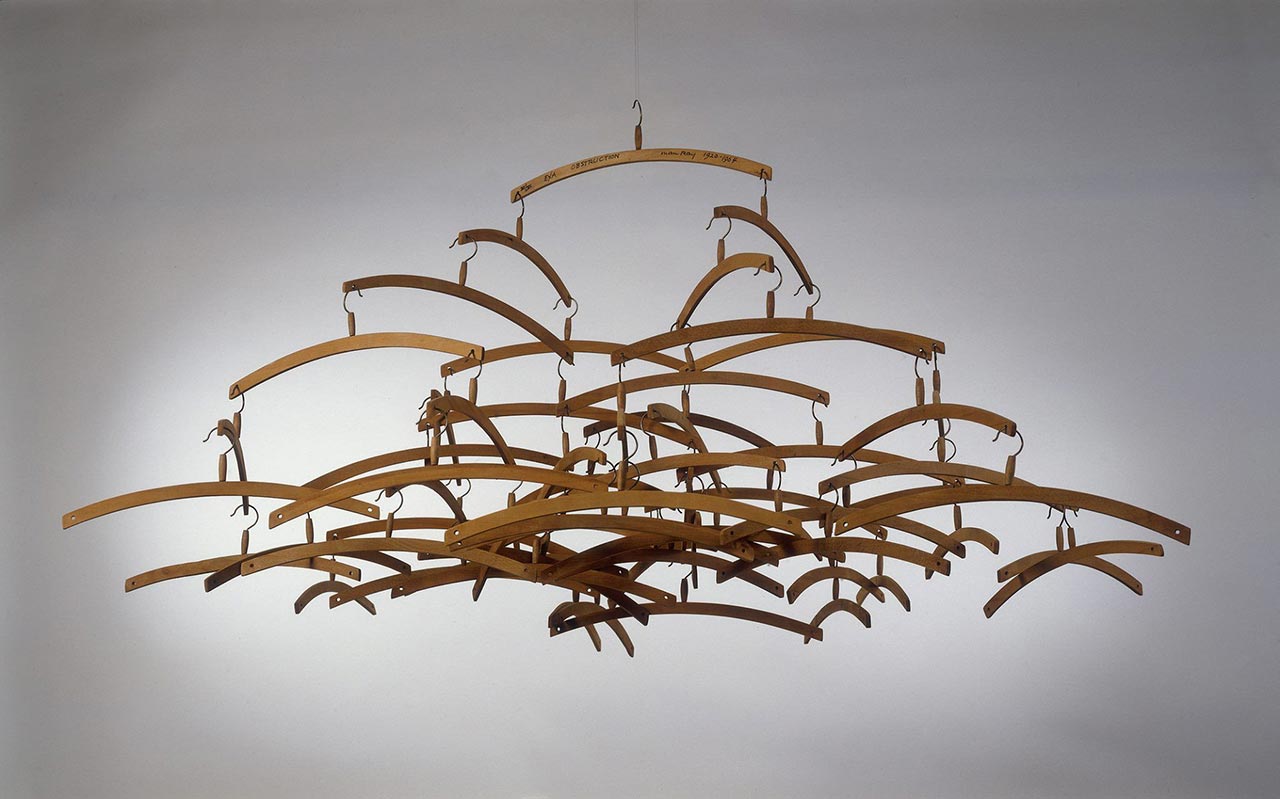
A missing object, recreated by Man Ray in 1947 Coathangers 110 x 120 x 120 cm ©Man Ray 2015 Trust Obstruction 1920 A missing object, recreated by Man Ray in 1947 Coathangers 110 x 120 x 120 cm “An object comprising 63 coat hangers, mathematically hooked to one another, as they consist of equations: they are hooked so as to form an arithmetical progression; firstly, one; then, on each side, another, which adds to two and, on these, two more, which adds up to four; then, eight, as so on up to the sixth row having 32, totaling 63 hangers! I could place many more of them, until they fully took up the gallery, but thus, there would be no way to come in there and see the pictures hanging, and this is logically called Obstruction”.
Man Ray
