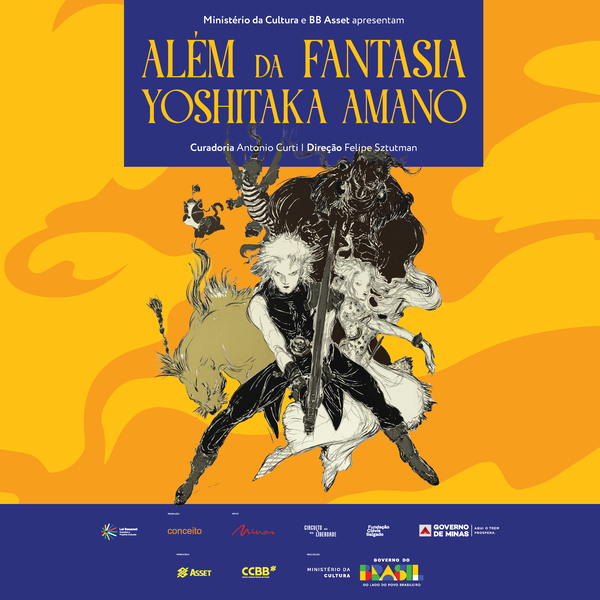
Beyond Fantasy - Yoshitaka Amano
BB Asset
BB Asset, the largest fund manager in the country, manages approximately R$ 1.8 trillion in net assets and is recognized for the excellence of its management, holding the highest ratings from the credit agencies Fitch Ratings and Moody’s. With more than 1,200 funds, a highly qualified team, and millions of investors, we develop solutions that address the needs of different profiles, always guided by technical rigor, stability, and a continuous focus on performance. Our mission goes beyond asset management, our core business. As leaders in the sector, we recognize the responsibility we carry in fostering a society that is more deeply connected to knowledge, and that promotes fairness and inclusion. For this reason, we support initiatives that expand access to art, encourage reflection, and provide enriching experiences. Supporting the exhibition “Yoshitaka Amano – Beyond Fantasy” is part of this commitment. For us, investing in culture also means investing in human and social development. By sponsoring initiatives such as this one, we offer unique experiences that surprise audiences and generate value for society.
CCBB
"Banco do Brasil presents the exhibition YOSHITAKA AMANO – Beyond Fantasy, a journey through the universe of the Japanese artist who redefined the aesthetics of contemporary illustration. The exhibition brings together original works coming directly from Japan, as well as an immersive experience that expands his creations beyond the frame, allowing the public to inhabit the ethereal worlds conceived by Amano. From the conceptual linework of Final Fantasy to the mystical visions of Devaloka, the exhibition reveals the trajectory of a creator who moves between tradition and innovation, between mythologies, pop culture, and spirituality, offering reflections on imagination as a transformative force in society. By presenting this project, the Banco do Brasil Cultural Center seeks to inspire wonder and foster meaningful exchanges with the public, while also valuing the interconnectedness of knowledge and artistic languages, strengthening the Brazilian audience’s connection with culture in its many forms and origins. Centro Cultural Banco do Brasil
Curatorial
Art is an invitation to transcendence, a portal to a universe where the boundary between the physical and the fantastical is as delicate as the line that separates dream from reality. Within the artistic spectrum, one may immerse oneself in a space where imagination knows no limits and beauty manifests in its purest, most ethereal forms. These experiences are not merely visual; they are invitations to explore unknown realms and reflect upon the subtle nuances of human existence. Yoshitaka Amano is a poetic fusion of dream and reality, an intricate tapestry weaving together the mythological, the fantastical, and the surreal into a unique visual narrative. His work transcends the conventional boundaries of illustration and design, positioning itself in a realm where art not only adorns or tells stories, but also evokes profound sensations, questions, and reflections. Amano unites his Japanese traditional heritage with influences drawn from Art Nouveau, Surrealism, and Pop Art, creating a visual language that is both ancestral and innovative. His creations inhabit a dreamlike space, merging elements of nature, technology, and fantasy, and reflecting a worldview that embraces both past and future. Whether through the striking landscapes and characters of Final Fantasy, which defined the visual identity of one of the world’s most beloved video game franchises, or through the dark, gothic narratives of Vampire Hunter D, Amano creates universes where beauty intertwines with the strange, capturing the essence of adventure and mystery. His collaborations with icons of pop culture and global brands, from DC Comics to projects with Vogue, demonstrate his versatility and his ability to introduce his extraordinary world across multiple media. With his ethereal palette and distinctly fluid style, Yoshitaka Amano invites us to explore universes where beauty reveals itself in both light and shadow, and where every brushstroke becomes an invitation to journey beyond fantasy. Antonio Curti Curator
Institucional
The exhibition Beyond Fantasy was born with a central objective: to present Yoshitaka Aman while preserving the integrity of his original work and simultaneously expanding its sensory reach. The project began with the premise of creating an experience capable of revealing the delicacy of the line, the narrative force, and the imaginary dimension present in each creation. This vision guided the development of an exhibition that integrates curation and technology to translate the artist's sensitivity across multiple scales. The arrival of the original works from Japan required extensive planning and rigorous conservation protocols. Still, one question continued to drive the project: how to take Amano beyond the frames? How to allow visitors to enter his worlds rather than merely contemplate them? As you move through the exhibition, you will encounter the original works in their physical integrity. At the end of the path, an immersive room developed in partnership with AYA Studio proposes another passage: into the works. The project began with a technical study on how to expand the illustrations beyond the two-dimensional support. Each image was digitized, cut out, separated into layers, and transformed into movement, always respecting the fluidity of the original line and the poetic intensity that characterizes it. The chosen series was Devaloka, a Sanskrit term meaning ""world of the gods"", the plane where devas dwell in Hindu and Buddhist cosmology. Developed since the late 2000s, this series synthesizes all his artistic influences into a personal mythology where Eastern and Western references converge. Incandescent colors applied on aluminum panels with metallic automotive paint, winged figures, gods and demons with ethereal features, psychedelic creatures, and elements of science fiction compose a universe where time dissolves between the material and the spiritual. Thirteen works were selected for their visual potency. The challenge was not to animate, but to reveal what already exists latent: waves that expand, serpents that circulate, characters that breathe. Amano always thought in flow. His scripts for animation show that he never imagined static images, but continuous transformations. Therefore, at the end of this journey, projection mapping on walls and floor, synchronized with sound design, will create an environment in which you will not merely observe the works, but inhabit them for fifteen minutes. Felipe Sztutman Executive Director
The artist
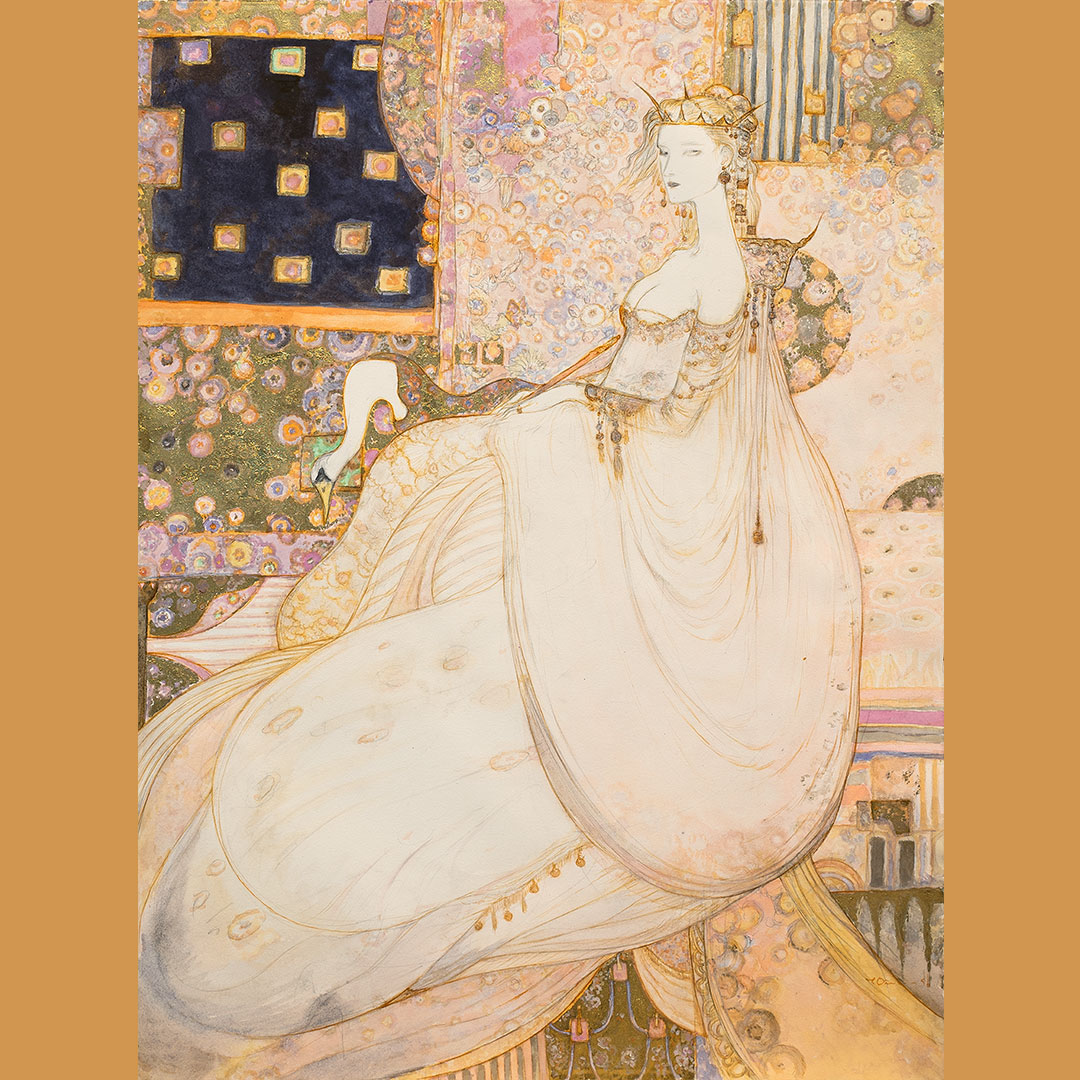
Welcome to the exhibition Beyond Fantasy, by the artist Yoshitaka Amano, and to the CCBB. This inclusive audio guide was created to accompany your visit with accessibility resources, offering detailed descriptions of the main works in each section of the exhibition. Audio description expands access to visual artworks, allowing everyone to experience the visual and poetic aspects of Amano’s creations. Throughout the exhibition, you will have access to the room texts and to the descriptions of selected works that represent each of the sections. The Artist Yoshitaka Amano was born on March 26, 1952, in Shizuoka Prefecture, at the bottom of Mount Fuji, a symbol of beauty and transcendence, that seems to have shaped his artistic sensibility from an early age. Raised in a modest family, he was the youngest of four siblings. His father, Yoshio Amano, was a craftsman skilled in traditional wood lacquer techniques, a craft that employed intense black, red, and gold pigments—colors that would later become essential trademarks in Amano’s work. From childhood, Amano was fascinated by stories and characters, spending hours copying the creations of Osamu Tezuka, the legendary author of Astro Boy and pioneer of modern manga. In 1967, at the age of 15, he went through a training and certification upon joining Tatsunoko Production, one of Japan’s most innovative animation studios. There, he began a journey that would transform him into one of the most influential artists of the 20th and early 21st centuries. Amano’s universe transcends categorization—he is a painter, illustrator, designer, visual storyteller, and creator of mythologies. His work moves between the sacred and the profane, the pop and the sublime. From the vibrant characters of Tatsunoko to the ethereal worlds of Final Fantasy; from the multicolored goddesses of Candy Girl to the mystical visions of Devaloka; from the melancholic gothic of Vampire Hunter D to the silent poetry of Angel’s Egg—from art galleries across East and West to prints for the world’s great fashion houses—Amano has built a multiverse where art, spirituality, fantasy, and imagination coexist. The exhibition is structured into seven sections—Tatsunoko, Final Fantasy, Candy Girl, Devaloka, Vampire Hunter D, Angel’s Egg, and Collaborations—revealing the multiple dimensions of an artist who has never accepted boundaries. Artwork Swam Maidens (think like Amano Artbook), from 1996, measures 93.2 centimeters in height by 73.4 in width, and was created using colored acrylic with gold pigment and gold leaf. The piece depicts a seated female figure, slightly turned to the side, looking toward the viewer. She is enveloped in a long, light-colored dress with long sleeves and exposed shoulders, which spreads across the foreground in soft, translucent layers. The fabric, in shades of white, cream, and sepia, seems to almost float, reinforcing the ethereal quality of the image. The woman rests with her torso gently inclined, her neck elongated, and her face serene, with half-closed eyes. Her hair, gathered in an arrangement adorned with a small golden ornament resembling a crown, echoes the delicacy of her gestures. Beside her, a white swan stretches its neck toward the ground. The background is richly ornamented with circular and geometric patterns in gold, lilac, and pink, resembling finely decorated wallpaper. On the left side, a dark rectangular area dotted with golden squares creates a contrast with the luminosity of the figure. The palette is soft and radiant, blending delicate whites with golden highlights that evoke aged gold. Everything in the composition appears light and suspended, as if the character were positioned between the tangible world and a dreamlike space. Swan Maidens conveys stillness, elegance, and an almost ethereal sense of presence, in which figure and environment merge with naturalness and delicacy.
Tatsunoko
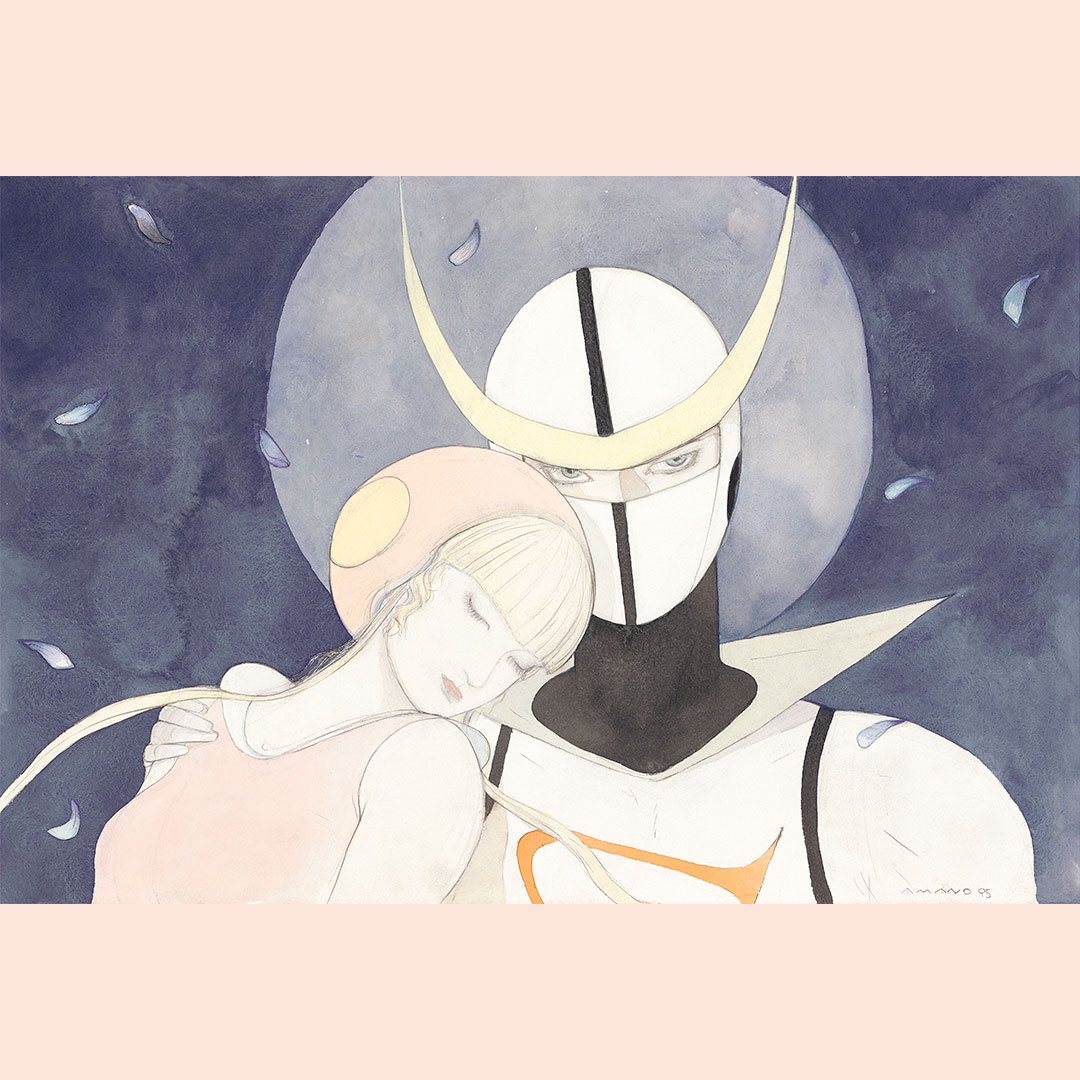
In 1967, Amano found in Tatsunoko Production the perfect laboratory for his artistic growth. At just 15, he completed the studio’s training and certification program and remained there until 1982. During this time, he contributed to landmark productions such as Speed Racer, Gatchaman, and Tekkaman: The Space Knight. His talent quickly caught the eye of Tatsuo Yoshida, the studio’s founder, who promoted him from animator to character designer—a groundbreaking role at the time that fused art with visual storytelling. It was during this period that Amano developed his signature style: characters with elongated, ethereal features; vibrant yet tragic worlds; an aesthetic that merged Japanese graphic design with Western art forms. At Tatsunoko, he learned to give soul to lines and color to ideas—forever transforming Japanese animation. This formative era is the cradle of everything that followed. The Amano who paints angels, vampires, and goddesses was born, essentially, in this studio. The artwork Casshern and Luna, from 1995, measures 49 centimeters in height by 67 centimeters in width and was created using ink on paper. In this delicate and melancholic composition, Amano portrays Casshern and Luna—characters from the Tatsunoko universe—immersed in a silent and dreamlike atmosphere. The painting, in soft shades of lilac, blue, cream, and pink, shows the pair against a nocturnal background, in front of a large circular moon that occupies the center of the scene and seems to radiate silvery light. The figures are shown from the chest up, close together. Casshern wears a white suit of armor with black details and soft orange, almost golden, accents. His helmet covers his entire face, leaving visible only his eyes, which look directly at the viewer. At the top of his head, a large curved piece in a cream tone rises like a horn or crescent, extending the glow of the moon behind him. The figure conveys strength and serenity, like a still guardian in the middle of the night. Beside him is Luna, resting her head on Casshern’s chest. Her eyes are closed, and her expression is calm, almost asleep. She wears a pink outfit with short sleeves, and her blond hair, cut in a straight and delicate style, follows the curve of her face. Casshern surrounds her with one arm in a gesture of protection and tenderness. The dark blue background is dotted with small white fragments that resemble petals floating in the air. They seem to fall slowly, like snowflakes or suspended lights, reinforcing the sense of calm and of time standing still. The brushstrokes are translucent and the use of color is minimal, which highlights the contrast between the serenity of the couple and the cold glow of the moon. The entire composition is built with precision. There is no excess or noise—only the meeting between light and silence. Its simplicity reveals a balance between the human and the mythical, between a tender gesture and a heroic dimension. Casshern and Luna is both a portrait of love and a symbol of devotion, painted with great delicacy.
Vampire Hunter D
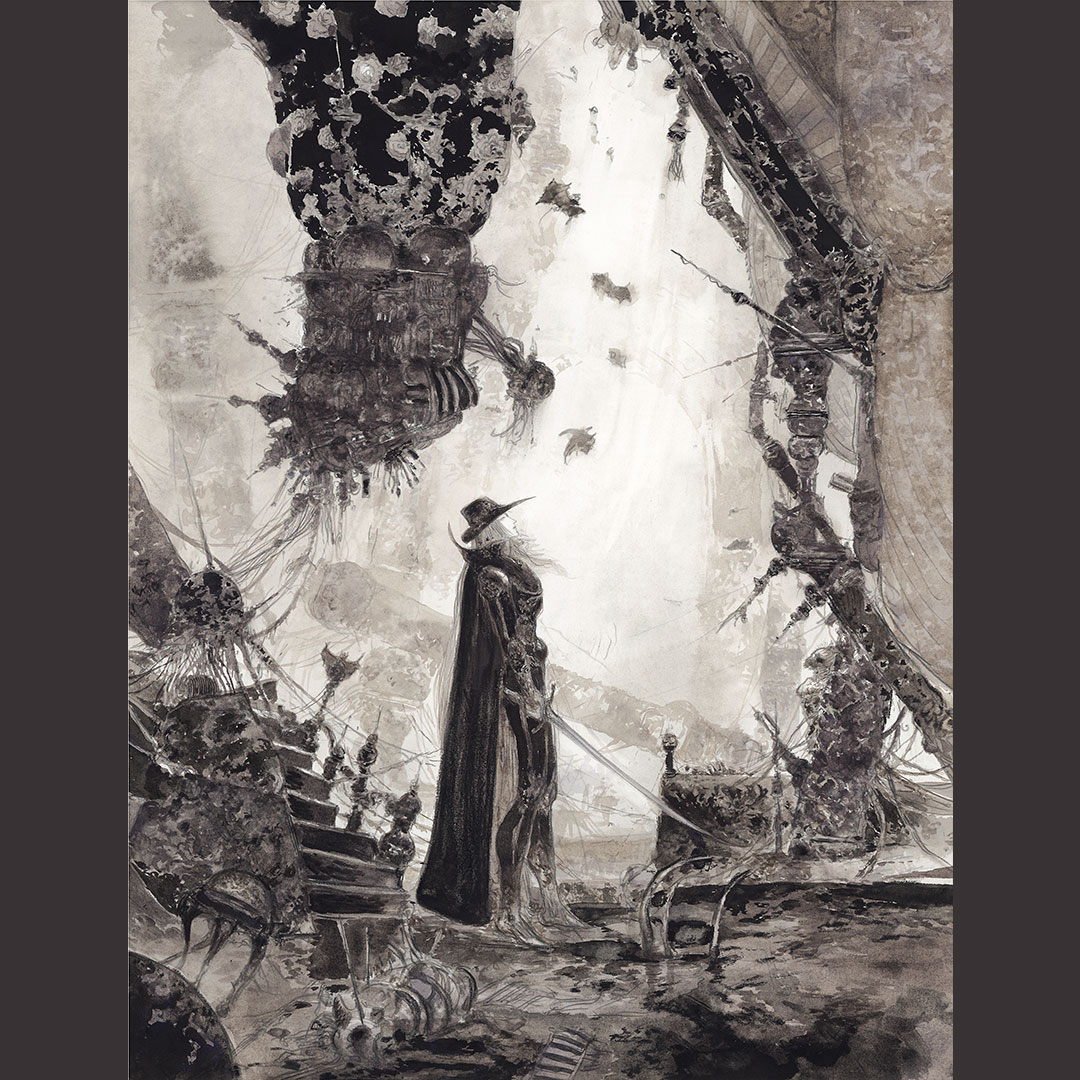
In the dark universe of Vampire Hunter D, Amano joined writer Hideyuki Kikuchi to create a gothic epic blending science fiction, horror, and tragic poetry. His illustrations capture the silence and elegance of the protagonist—a lonely vampire who hunts his own kind—with melancholic and enigmatic beauty. Amano’s aesthetic for Vampire Hunter D is profoundly cinematic: dense shadows, baroque details, and subtle contrasts between the grotesque and the sublime. He transforms the novel’s post-apocalyptic world into a visual experience where time feels suspended and every character carries the weight of centuries. This collaboration established Amano as one of the greatest illustrators in the realm of fantasy. His art gave the series a mythic dimension, making it an aesthetic reference for an entire generation of artists and animation directors. The artwork Encounter, created in ink on paper and measuring 77.5 centimeters in height by 61.5 centimeters in width, depicts a grand and somewhat somber scene built in tones of sepia, black, and gray. At the center stands the protagonist, shown in profile, wearing a form-fitting black armor and, over it, a long dark cloak that opens in heavy folds and touches the ground. She wears a wide-brimmed hat, and strands of light hair fall along the side of her face. Her head is lifted, facing upward, as if confronting something immense before her. In one hand, she holds a long sword, angled downward and forward. Her stance is firm and silent, giving the impression that she is awaiting a decisive event. To the right, a colossal form dominates the scene. It rises from the ground toward the sky, crosses through the composition, disappears from the frame, and then bends back over the heroine, drawing a vast arc around her. The surface of this entity — part machine, part creature — is composed of cables, tubes, metallic components, and corroded organic masses. Small points of greenish light are scattered across its structure, suggesting some internal energy. This monstrous presence is what gives meaning to the title of the work: the “encounter” between the solitary female figure and the creature. At the bottom, the terrain is uneven and muddy, covered with bone fragments, gears, broken metallic structures, and shards resembling shells or helmets. On the left, smaller elements of this same landscape of debris appear, as if they were ruins of ancient machines or remains of collapsed constructions. The vertical composition emphasizes the contrast in scale between the heroine and the gigantic form before her. The textures are fine and detailed, creating a space that seems made of dust, rust, and mist. The restricted palette, in variations of brown and black, intensifies the apocalyptic atmosphere. Encounter captures the moment when two forces draw near: the solitary figure of the hunter and the monumental mass of the machine-creature. It is an image of confrontation and stillness, where horror and beauty meet in a single scene suspended in time.
Final Fantasy
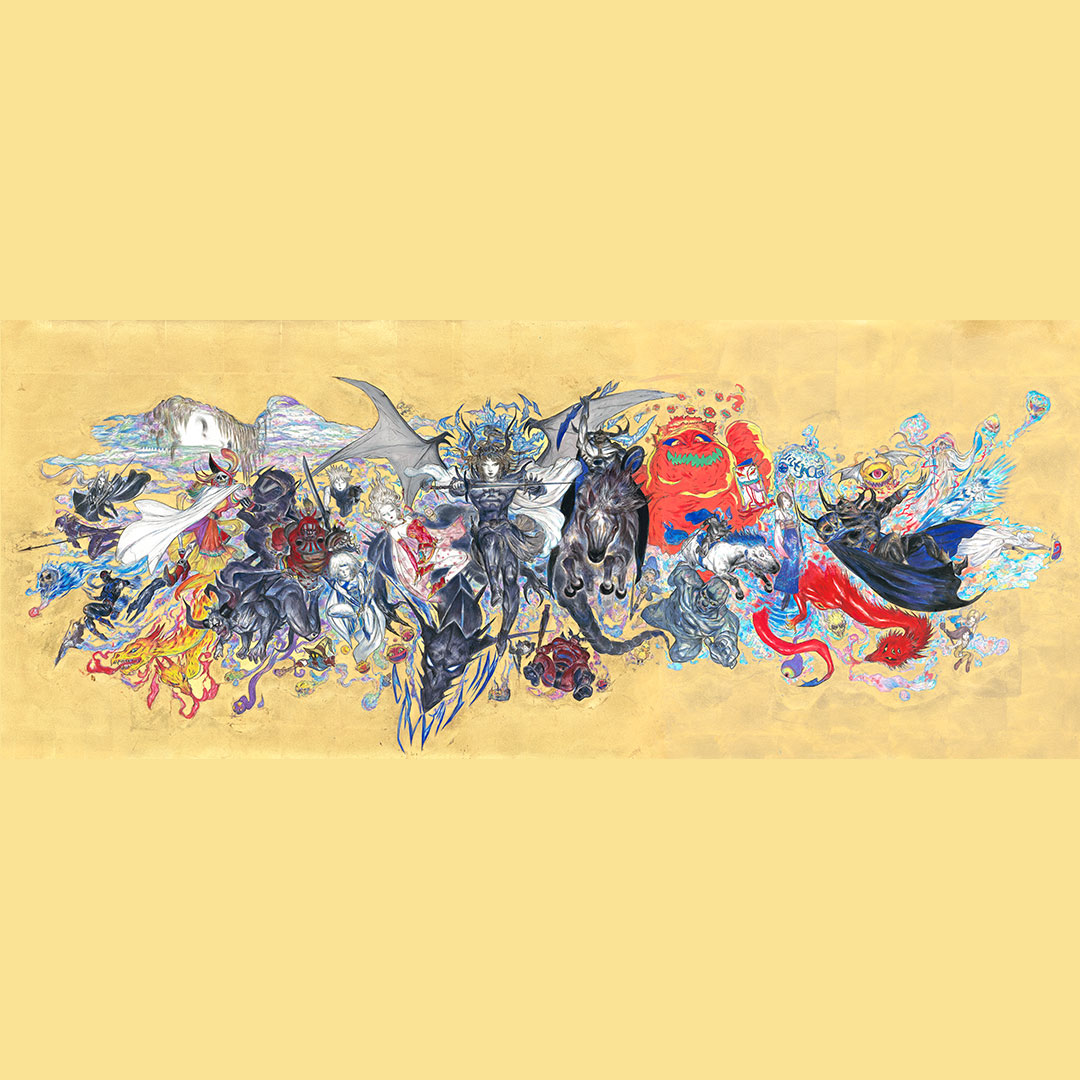
Since 1987, Amano has been the visual architect of Final Fantasy, the franchise that revolutionized video games and redefined modern fantasy. His art gave shape to timeless heroes and heroines, ethereal creatures, and entire worlds—creating a contemporary mythology that merges visual poetry with technology. He played a crucial role in establishing the series’ visual identity, contributing with his artistic vision from the very first game. His distinctive style—characterized by fluid lines, vibrant colors, and a fusion of fantastical elements with Japanese tradition—helped craft the iconic aesthetic that became synonymous with Final Fantasy. At the time, SquareSoft sought an artist with a mature style to contrast with competitor Enix, whose flagship series (Dragon Quest) featured Akira Toriyama’s cartoony art. Amano not only met that criterion but was already admired by Final Fantasy’s creator, Hironobu Sakaguchi. With delicate lines and almost baroque compositions, Amano brought to the games a sense of grandeur and melancholy rarely seen in the genre, elevating them to the level of fine art. He designed not only characters and worlds but also logos and emblematic images that became symbols for an entire generation. Even after the advent of 3D graphics and the arrival of new artists, his aesthetic remains the visual heart of the saga—the bridge between the human and the imaginary. Every stroke of Amano’s hand still resonates in today’s productions, ensuring that the lyrical and timeless spirit of Final Fantasy endures, unmistakable and eternal. The artwork Final Fantasy 35th Anniversary is a horizontal painting, executed in ink on paper, measuring 83 centimeters in height and nearly two meters in width, in which dozens of characters and creatures float against a golden background. The gold’s radiance dominates the entire surface, creating a luminous and reverent field, as if it were an altar in homage to imagination itself. At the center of the composition, a winged warrior with golden hair wields a silver sword. He rises with a serene and determined expression, wrapped in a white cloak that seems to be made of wind. His open wings resemble those of an ascending angel. Around him, figures rendered in soft shades of lilac and silvery gray form a marching group of heroes—each with distinct garments and gestures—knights, mages, and archers representing different generations of the series. On the left, dark creatures appear in tones of blue, bright yellow, and red: a dragon with open wings, a phoenix in flames, and hooded warriors. Their forms overlap like fused memories. On the far right, the balance shifts—the colors become more vivid and contrasting. A large orange monster with round eyes and a fierce grin occupies the space, surrounded by characters in blue and white, among them a woman with long silver hair and a sky-blue dress, delicately holding a scepter. The composition is dense and rhythmic: characters and monsters interlace in a continuous spiral, with fine, elegant lines guiding the viewer’s gaze from one end of the painting to the other. The gold background envelops all the figures, unifying them within the same plane of light—a symbolic sky that reflects the grandeur of the saga. Amano’s technique combines precision and lightness: almost calligraphic strokes, transparencies, and subtle watercolor-like washes of color. Up close, one can perceive the delicacy of the faces and the movement of the garments, while from afar the image becomes a single golden wave, where the epic and the spiritual merge. The work functions as a visual synthesis of a universe that transcends the game: a panel of collective memory shared by millions of players and spectators. In Amano’s gesture, myth is renewed—a chorus of heroes and monsters eternally suspended in light.
Angel's Egg
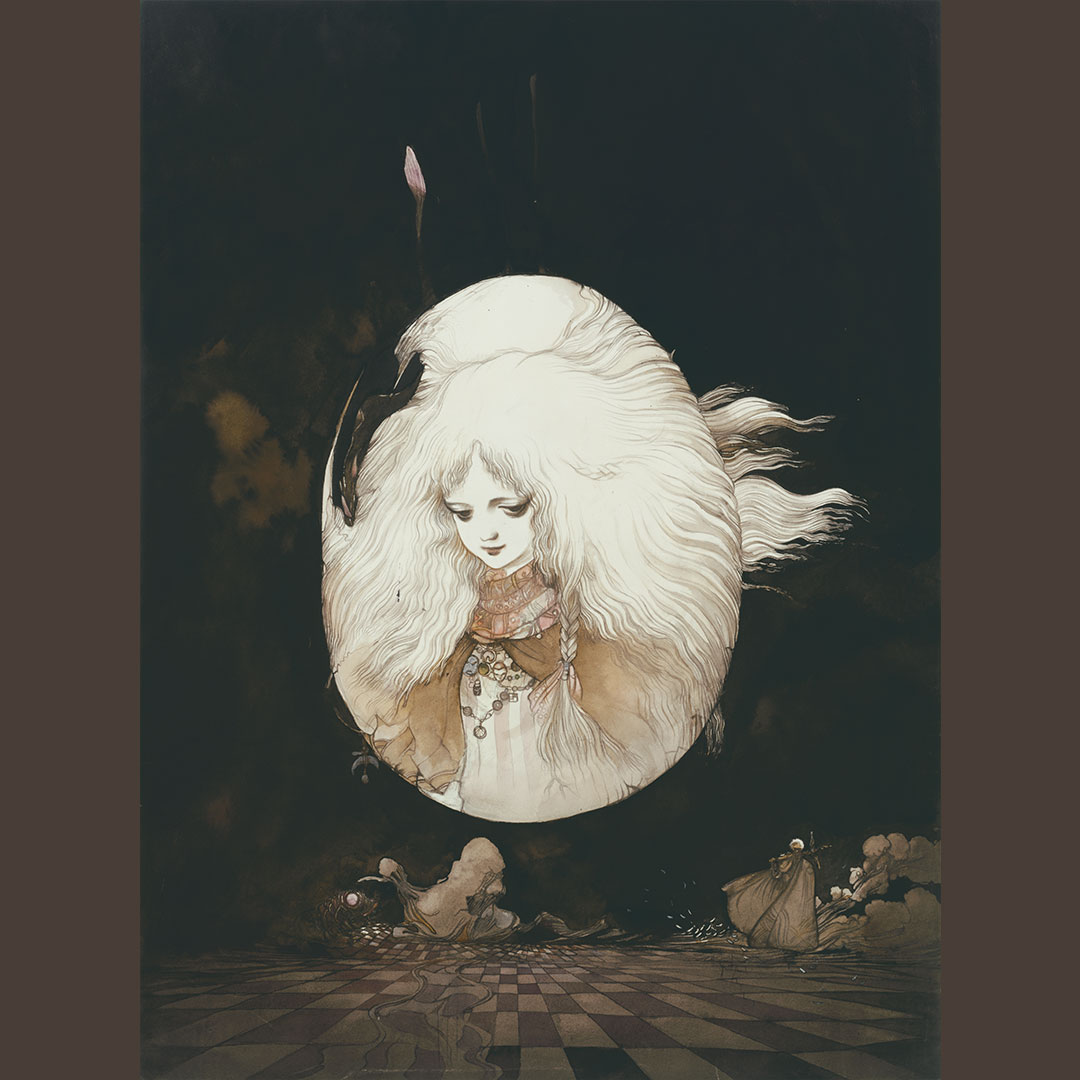
Between 1982 and 1986, Amano entered an experimental phase that culminated in the film Tenshi no Tamago (Angel’s Egg), created in collaboration with visionary director Mamoru Oshii (Ghost in the Shell). The two had previously worked together at Tatsunoko on several Lupin III film versions that were never released. This nearly dialogue-free animation is a meditation on faith, solitude, and creation. Each scene is a moving painting: a gothic architecture submerged in shadow, fragile and luminous figures walking through a timeless world. With only two minutes of dialogue in over an hour of runtime, Angel’s Egg is pure imagery—a visual metaphor of waiting and mystery. The film established Amano as a visual poet, someone who doesn’t need words to tell a story. It is perhaps his most spiritual work — a dream drawn in light. The artwork Angel’s Egg (1985), an original drawing on canvas with acrylic and colored ink on paper, measures 86.5 centimeters in height by 67.4 centimeters in width, and features a large white egg at the center of the composition. The egg has a smooth, luminous surface modeled by soft shadows that give it volume, and inside it we see the figure of a young girl shown from the chest up. Her face is delicate, with a serene expression turned slightly downward. Her eyes are half-closed, conveying introspection. The girl’s hair is extremely voluminous and fills almost the entire interior of the egg. It spreads in wide, irregular waves, drawn with fine, long strands that form a luminous mass in tones of sepia, white, and brown. On the left, part of her hair twists and curves outward, creating a sinuous shape that briefly resembles the silhouette of a creature. On the right, another lock extends beyond the edge, following the undulating flow of the strands. She wears clothing in earthy tones, with layers of light fabric around her neck. A necklace with small beads and ornaments hangs over her chest. Her hands are not visible, hidden by the framing and the position of her body. At the bottom of the composition, the ground is tiled, composed of squares and diamonds in brown and grayish tones. The pattern recedes in perspective, creating depth. Just below the egg, there is a rounded, blurred form resting at the center of the floor, possibly suggesting the silhouette of a figure seen from behind, like a distorted reflection—although its nature remains ambiguous. On the right side appears the figure of a character wrapped in a long cloak, also in sepia and grayish tones. Standing upright, the folds of the fabric extend downward in organic shapes until they touch the floor. This figure holds a crucifix with one hand, resting it on their shoulder as if bearing its weight or preparing to proceed cautiously. The entire background is filled with deep shadows in black and brown, creating the impression of a vast and silent space devoid of light. This darkness makes the egg’s glow stand out, radiating the light that organizes the whole scene. The contrast between the dense environment and the inner luminosity of the egg reinforces the sense of suspension and mystery. The image conveys a dreamlike and contemplative atmosphere. The girl appears protected and isolated within her own halo of light, while the surrounding figures and forms suggest an enigmatic, spiritual world characteristic of the universe of Angel’s Egg.
Collaborations
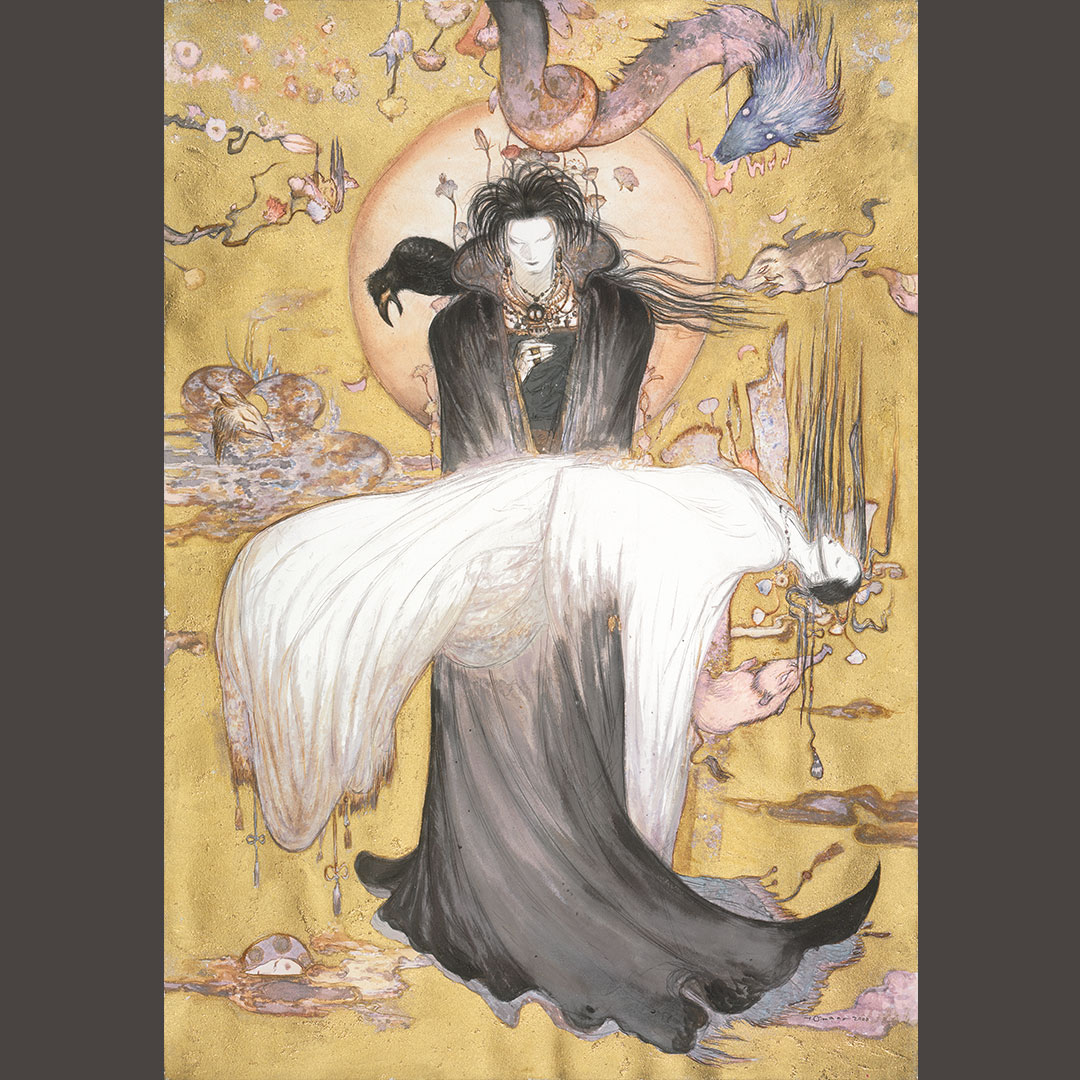
From Neil Gaiman’s Sandman to Vogue Italia, passing through Magic: The Gathering, DC Comics, and other international collaborations, Amano continuously expands his creative horizons. His art inhabits galleries and magazines alike—book covers, collectible cards, and digital universes—all bearing his unmistakable ethereal signature. For Sandman: The Dream Hunters, Amano created imagery that captured the dreamlike and somber tone of Gaiman’s narrative, transforming the comic into a visual tale of rare delicacy. For DC Comics, he reimagined icons such as Batman and Catwoman through the eyes of a Japanese artist who views heroes as mythological archetypes. His collaboration with Magic: The Gathering brought new visual dimensions to the game, while his participation in Vogue Italia’s historic 2020 issue—its first edition without models, replaced entirely by illustrations—redefined the concept of feminine beauty. These collaborations reveal an artist unbound by the confines of fine art—one who dialogues with design, fashion, literature, and entertainment. Amano is a creator who turns everything he touches into myth and image, transcending boundaries and reaffirming his relevance with each new world he enters. The artwork The Sandman: The Dream Hunters, undated, measures 86.2 centimeters in height by 63.5 centimeters in width and was created using ink on paper. The piece presents a scene of rare intensity and melancholy. At the center, a man with long black hair carries in his arms the inert body of a woman dressed in white. Her head hangs back, revealing her exposed neck and the golden strands of a necklace that blend into the fabric of her clothing. Her dark hair lifts upward, as though the downward movement of her body had just taken place. Her face — very pale and delicate — shows closed eyes and reddened lips. Her left arm hangs along her body. Her dress, translucent and voluminous, falls in soft waves, dissolving at the base of the composition as if made of mist. The man wears a dark mantle of thick, heavy fabric, contrasting with the lightness of the figure he holds. His face is pale and serene, with a contained expression. His long, disheveled hair frames his face and fans out like black flames. Resting on his shoulder is a raven, and behind him, a golden sphere surrounds his head like a halo. This circular light dominates the scene and reinforces its symbolic dimension, evoking both a sun and a sacred aureole. The background is covered with golden leaves and diffuse shapes—birds, serpents, and clouds—stretching across tones of bronze, blue, and ocher. Above the central pair, a sinuous dragon crosses the sky, with a reddish body and a blue head, following the direction of the man’s gaze. The ground is irregular and liquid, dotted with small organic forms suggesting stones, bones, and fragments of flowers. The contrast between the two bodies—the masculine, upright, and dark, and the feminine, curved and luminous—creates the emotional axis of the work. The tension between strength and fragility, death and transcendence, is heightened by the restricted palette: black, white, gold. The metallic surface of the background reflects the light, making the scene appear suspended in time. The Sandman: The Dream Hunters is an image of farewell and devotion, a silent elegy in which the weight of the body and the glow of gold find balance in a single gesture. Amano transforms myth into painting, and mourning into beauty.
Candy Girl
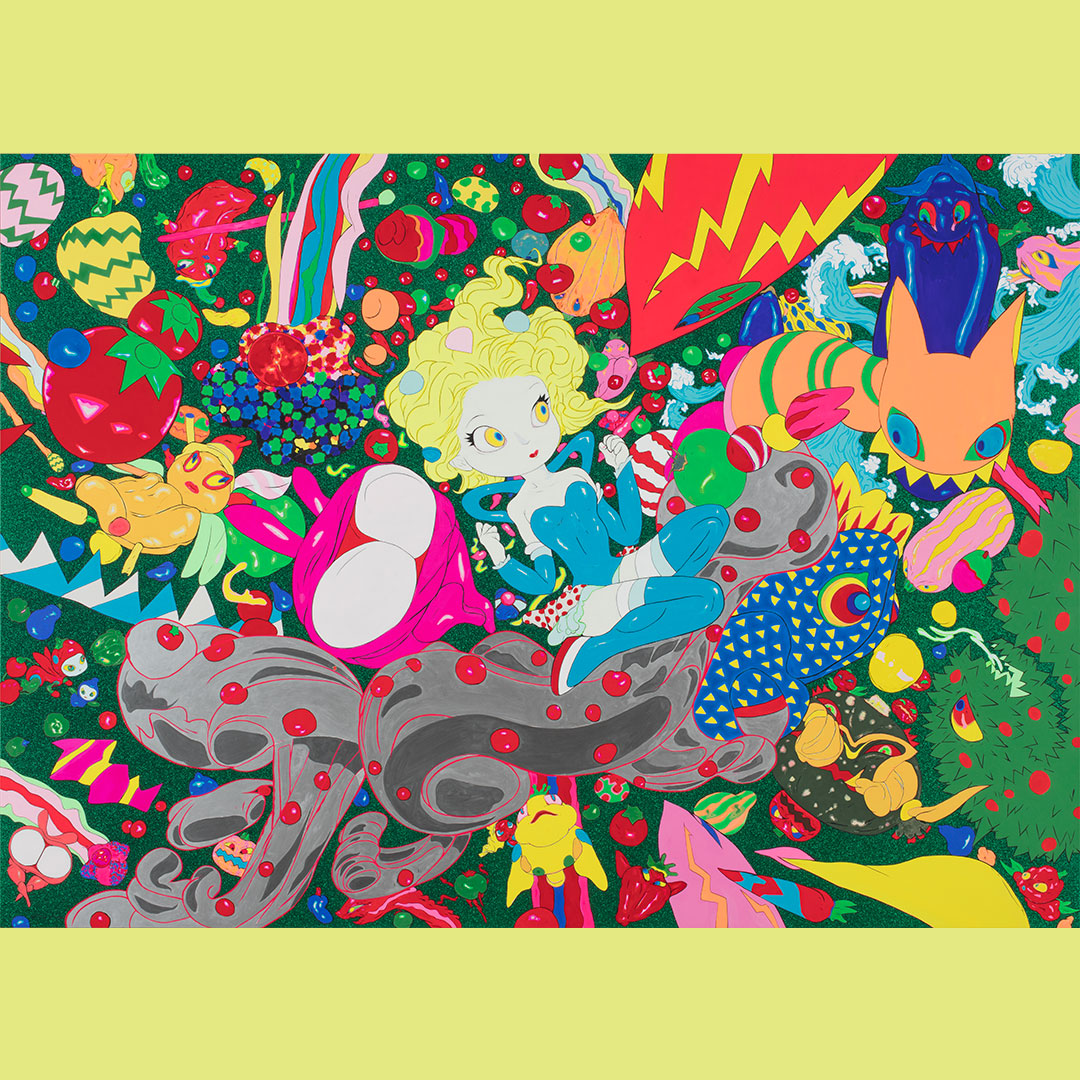
Created in the early 2000s, Candy Girl stands out in Amano’s vast portfolio for its unique and stylistic approach that blends elements of fantasy, pop art, and surrealism. Conceived as a project that allowed Amano complete creative freedom, Candy Girl pays homage to his roots in character design and the pop art that so deeply influenced him—such as Hello Kitty and Betty Boop—while following in the footsteps of American pop artists like Andy Warhol and Roy Lichtenstein. The works employ vibrant, saturated colors that reflect Amano’s ability to explore themes of innocence, femininity, and the complexities of coming of age in an imaginary world filled with vivid hues and dreamlike shapes. His illustrations for Candy Girl display his trademark fluid lines and masterful use of color, creating images that are both ethereal and profoundly emotional—balancing innocence and seduction with grace. This project exemplifies Amano’s ability to transcend the boundaries between artistic media and genres, solidifying his reputation as a versatile and innovative creator. The artwork Candy Girl M-14 is a spectacle of color and energy. Measuring one meter in height and one meter forty in width, the aluminum panel reflects light and intensifies the vivid brilliance of the paints. The background is dark, dotted with tiny sparkling particles that resemble outer space, filled with sweets, fruits, mushrooms, plants, and fantastical creatures. At the center of the composition, a young girl with curly blond hair and a curious gaze appears to float, seated with her legs folded behind her on a sinuous form resembling a gray trunk covered with red circles that recall ripe tomatoes. She wears a blue off-the-shoulder leotard with long sleeves, a short, fluttering white skirt with red polka dots, and tight blue boots that extend up to her thighs, giving the impression of shiny, plastic-like material. Her fair skin contrasts with the vibrant setting, and her expression mixes innocence and provocation. With elbows bent, fists raised upward, and her body slightly tilted back, she observes the space around her as if awakening inside a colorful dream. Around the central figure, an explosion of shapes and colors dominates the scene. There are creatures that look like toys: an orange cat with blue eyes and sharp teeth, a yellow animal with open wings, stylized serpents, and small smiling monsters. Fruits and sweets appear mixed among these beings—strawberries, candies, tomatoes, eggs, blue waves, and red lightning bolts—forming a pop and chaotic universe. The colors are pure and saturated: shimmering greens, intense pinks, electric blues, luminous yellows, and bright reds. Each element seems to compete for the viewer’s attention, without any overpowering the others. There is a sensation of floating and vertigo, as if all the elements were orbiting around the girl. Amano transforms the visual language of pop culture into a delirious spectacle, where the playful and the sensual blend without boundaries. Candy Girl M-14 is an image that evokes a dream—at once sweet and electric—one that never settles.
Immersive room
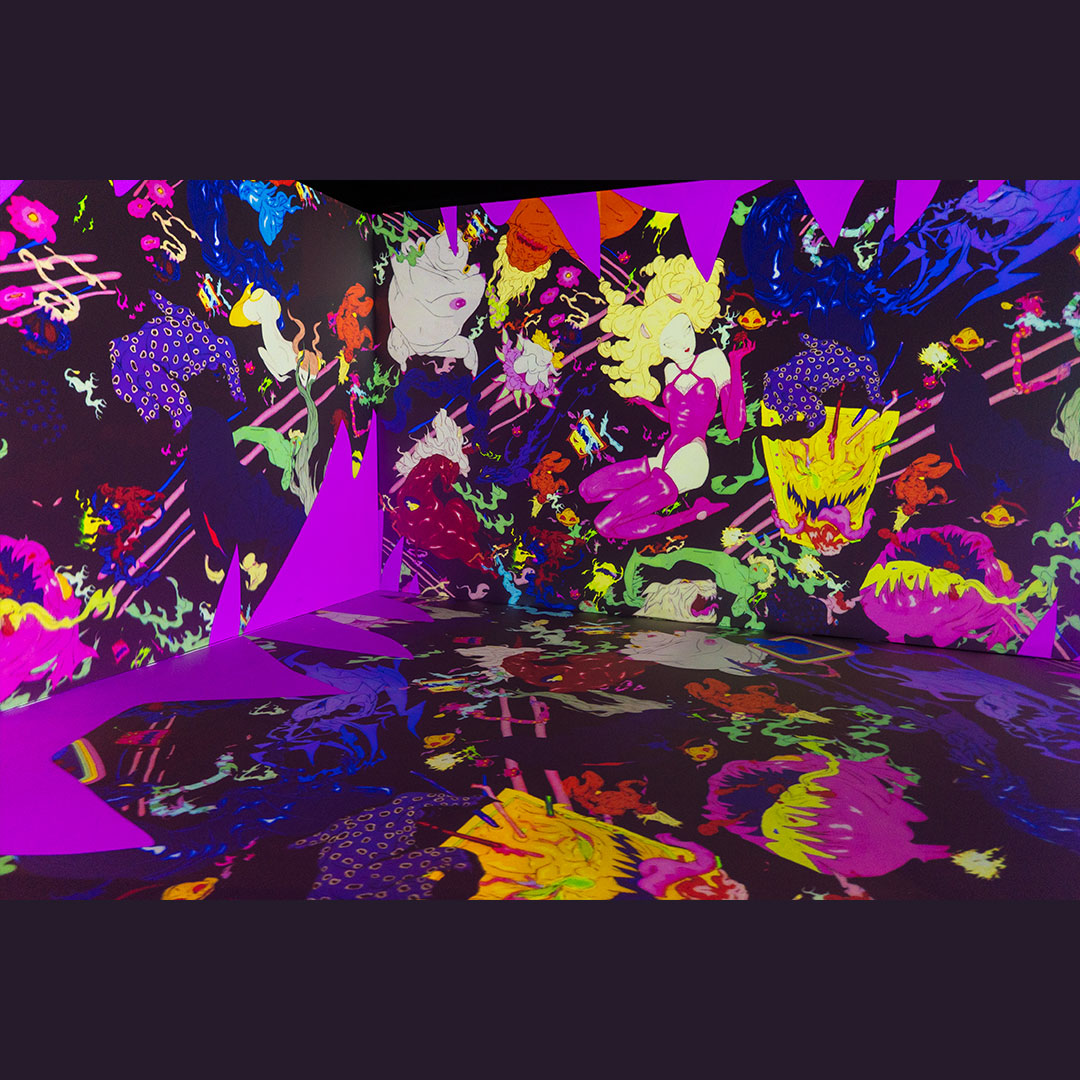
The exhibition Beyond Fantasy was born with a central objective: to present Yoshitaka Aman while preserving the integrity of his original work and simultaneously expanding its sensory reach. The project began with the premise of creating an experience capable of revealing the delicacy of the line, the narrative force, and the imaginary dimension present in each creation. This vision guided the development of an exhibition that integrates curation and technology to translate the artist's sensitivity across multiple scales. The arrival of the original works from Japan required extensive planning and rigorous conservation protocols. Still, one question continued to drive the project: how to take Amano beyond the frames? How to allow visitors to enter his worlds rather than merely contemplate them? As you move through the exhibition, you will encounter the original works in their physical integrity. At the end of the path, an immersive room developed in partnership with AYA Studio proposes another passage: into the works. The project began with a technical study on how to expand the illustrations beyond the two-dimensional support. Each image was digitized, cut out, separated into layers, and transformed into movement, always respecting the fluidity of the original line and the poetic intensity that characterizes it. The chosen series was Devaloka, a Sanskrit term meaning ""world of the gods"", the plane where devas dwell in Hindu and Buddhist cosmology. Developed since the late 2000s, this series synthesizes all his artistic influences into a personal mythology where Eastern and Western references converge. Incandescent colors applied on aluminum panels with metallic automotive paint, winged figures, gods and demons with ethereal features, psychedelic creatures, and elements of science fiction compose a universe where time dissolves between the material and the spiritual. Thirteen works were selected for their visual potency. The challenge was not to animate, but to reveal what already exists latent: waves that expand, serpents that circulate, characters that breathe. Amano always thought in flow. His scripts for animation show that he never imagined static images, but continuous transformations. Therefore, at the end of this journey, projection mapping on walls and floor, synchronized with sound design, will create an environment in which you will not merely observe the works, but inhabit them for fifteen minutes. Felipe Sztutman Executive Director The immersive room is completely filled with projections of intense, luminous colors. The walls and floor blend together without clear boundaries, and the space seems to expand, as if the visitor were standing inside a moving painting. The color palette is dominated by vivid neon tones — hot pink, fluorescent yellow, lime green, electric blue, and purple. These colors spread across organic shapes, fantastical figures, and abstract patterns that cover every surface of the room. On the walls, stylized and fantastical figures appear, such as a woman with voluminous blond hair, floating in midair, wearing a vibrant pink outfit and long boots. Her body leans slightly backward, as if suspended in the air. In various spots, hybrid creatures emerge — some shaped like colorful monsters, others resembling imaginary animals. There are also masks, eyes, and open mouths, drawn with bold lines and flat, saturated colors. On the highly reflective floor, the projected images create a mirror effect, multiplying colors and figures, as if the room were flooded with a dark liquid that reflects light. Three-dimensional neon-pink forms, prisms, triangles, and irregular-edged panels emerge from all sides and cut across the space. These physical elements reinforce the sensation of an immersive, multidimensional environment. The overall feeling is one of energy, creative chaos, and psychedelic fantasy. Shapes float, overlap, and distort, as if the room were alive—pulsing and in constant motion. The lighting gives the space a warm, electric, almost surreal atmosphere. The blend of fantasy and energy creates a unique sensory experience.
Devaloka
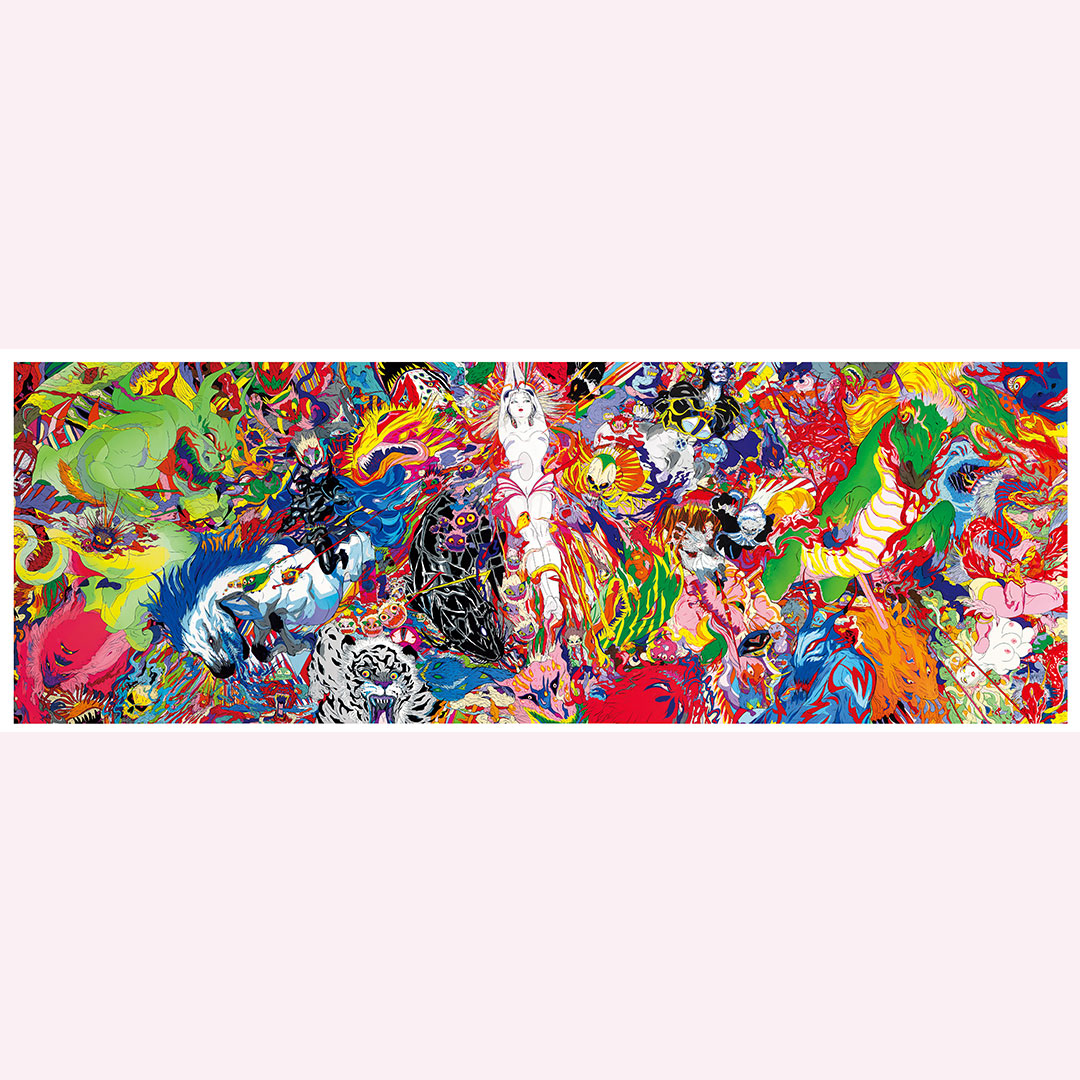
In Devaloka — a Sanskrit word meaning “world of the gods” — Amano gives form to his own cosmos. Incandescent colors, winged figures, imaginary temples, and golden constellations blend in a realm that seems to float between the physical and the spiritual. Each painting is a portal to the divine: gods, angels, spirits, and hybrid entities inhabit this universe where time dissolves. Devaloka is more than a series—it is a personal cosmogony. Here, Amano becomes not just an artist but a world-builder, reinventing myth in his own image. This phase synthesizes all that defines him: the fusion of technique and transcendence, tradition and futurism, body and dream. The work Devaloka, from 2008, is composed of seven aluminum panels which together measure two meters and forty in height by seven meters in width. Painted with automotive and acrylic paint, Devaloka unfolds as a whirlwind of forms and colors. Its monumental scale fills the viewer’s field of vision and creates the sensation of standing inside a universe in turmoil. Divine and monstrous creatures emerge from a vortex of intense colors—reds, yellows, blues, and greens—that seem to crash into one another and merge in constant motion. At the center of the composition, a woman rises in an upright position with her arms raised above her head and her gaze directed upward. She wears a white leotard that blends with her own skin, radiating light. The fabric reflects pink and golden tones, and around her body sparks and flames appear, as if she were the core of energy sustaining the entire scene. Her expression is serene, almost trance-like, contrasting with the chaos surrounding her. To the left, a white horse with a vivid blue mane charges diagonally forward with its front legs lifted. Its mane opens in thick, vibrant waves, like liquid flames. Mounted on the horse is a shadowy figure—a demon in black armor—riding it like an infernal warrior. Behind them, dragons and winged beings with sharp teeth intertwine in flames and red clouds. At the bottom, a white tiger displays long fangs and golden eyes, roaring toward the viewer. To the right, a green creature dominates the side of the panel. Its body resembles that of a serpentine horse, with broad muscles and an arched neck, but its head is monstrous, with glowing red eyes and a mane in shades of pink and lilac. It blends into other figures—birds, demons, and flaming faces—forming a mass of living energy. The viewer’s eye travels across the work as if moving through a dream; there is no hierarchy and no place of rest—everything vibrates. The long, fluid lines characteristic of Amano’s style and the saturated colors seem to pulse with their own energy. The sensation is that of witnessing a sacred apocalypse, where destruction and creation coexist.
Tactile piece - Sculpture
The sculpture created by visual artist Paulo Bordhin, in partnership with Mais Diferenças, draws inspiration from the characters conceived by Yoshitaka Amano in his drawings and paintings. It depicts a humanoid being—an ethereal, fantastical, and even heroic creature — formed from interwoven, twisted, and carefully crafted aluminum wires. A body made of living threads, as if each strand of metal were a pulsating muscle. The wires, in tones ranging from copper and bronze to red and iridescent reflections, intertwine organically throughout this elongated and vibrant body. The torso is composed of multiple dense spirals and twists that taper toward the waist, suggesting movement and flow. The arms are long and slender, made of tightly coiled wires, extended outward in an expressive gesture. One of the arms supports a compact sphere composed of a tangle of metallic wires, denser and more voluminous than those that form the rest of the body. The sphere has a textured, shimmering appearance, as if it were concentrating energy. The legs are equally elongated, formed from tightly twisted wires that descend in smooth curves to pointed ends, giving the impression that the figure is taking a light step or hovering. Some wires extend outward from the legs and torso, creating a sense of continuous movement or energy emanating from the structure. The head is small in proportion to the body, made from a cluster of finer wires that rise upward in small branching forms, resembling antennas or disheveled metallic hair—perhaps even a stylized crown. Or could they be thoughts escaping the body in unpredictable directions? The absence of defined facial features reinforces the abstract and expressive character of the piece. As one explores the figure from top to bottom, the visitor may feel that it is constantly transforming. It is like touching a body made of solidified energy, where each wire seems restless, searching for light, air, or space. It is a creature born of metal, yet vibrating as if made of wind—an ascending, weightless presence that seems on the verge of dissolving and, at the same time, on the verge of coming to life.
Tactile piece - Box
(Soon)