
Paul Klee - Unstable Balance
Introduction
Paul Klee

Paul Klee (1879–1940) is one of the most important artists of classic modern art. Born and raised in the Swiss capital of Bern, at a young age the artist was attracted to Munich, at that time one of the most important hubs of art. There he met his future wife, pianist Lily Stumpf, as well as the leading figures of the German avant-garde. Wassily Kandinsky introduced him to various artists, including Franz Marc and the members of the Der Blaue Reiter [The Blue Rider] group, and he began to frequent the city’s thriving cultural scene. Up to the much-remarked trip he took together with Louis Moilliet and August Macke to Tunisia in early 1914, Klee was outstanding as an exceptional draftsman. He later developed his own visual language, distancing himself from the model of nature, which he had studied intensely in his youth. In Tunisia he expanded his artistic repertoire, using small-format watercolors to create an abstract visual language while intensely exploring the use of light and color. Paul Klee – who had a German passport due to his father’s nationality – was drafted to serve in the military between the years 1916 and 1918 in World War I. As he did not need to fight on the battlefield, he had time to continue his art career, becoming one of the most prestigious artists in that period. For this reason, in 1921 he began to teach at the recently inaugurated Bauhaus, an avant-garde school of design and architecture located initially in Weimar before its transfer to Dessau, both in Germany. In this period Klee produced constructivist drawings and works exploring the relationship of colors. The artist gradually began to feel increasingly burdened by his classes, which left him little time left for his own artistic creation. In 1931, he transferred to the Düsseldorf Art Academy, where it was possible to organize his teaching duties more freely. After the National Socialists came into power, Paul Klee, like many of his artist friends, was persecuted and boycotted. At Christmas 1933, he and Lily emigrated to Bern, after the artist suffered attacks by the communication media and had his house searched. It was there in Bern that he spent his last years, living in isolation and developing a multifaceted and wide-ranging oeuvre until his death in 1940. Paul Klee – equilíbrio instável [Paul Klee – Unstable Balance] is the most complete retrospective on the artist ever held in Latin America, presenting a set of 123 artworks belonging to the collection of the Zentrum Paul Klee, located in Bern, Switzerland. Fabienne Eggelhöfer Curator – Zentrum Paul Klee
Childhood Drawings
Paul Klee

Paul Klee’s grandmother, Anna Catharina Rosina Frick, instilled in him the joy of drawing from a very young age and did not discourage him from using his left hand. Later, the artist himself defined these first drawings of his as illustrations of fantastic tales and scenes. As an adult, in 1911, Klee decided to organize the artworks he had produced up to then, in the form of a handwritten catalogue of works, only leaving out those earlier works he deemed as lacking in “creative self-sufficiency.” He recognized in the drawings from his childhood – as in archaic visual records – a naturalness of pictorial expression and reduction to the essence, which he strove to achieve in his artistic creation. Aware of this, he included some of these childhood drawings in his catalog of works.
Christmas Tree with Angel and Toy Train / Christmas Tree with Angel and Clock (Weihnachtsbaum mit Christkind u. Eisenbahn / Weihnachtsbaum mit Christkind u. Uhr)
Paul Klee

Pencil and chalk on paper on cardboard, two-part 24 x 32 cm Zentrum Paul Klee, Bern Christmas Tree with Angel and Toy Train, 1884, 3 Christmas Tree with Angel and Clock, 1884, 4 pencil and chalk on paper on cardboard, two-part 24 x 32 cm Zentrum Paul Klee, Bern Discovery of Childhood Klee’s childhood drawings had been kept for him by his sister Mathilde. In 1911 she gave them back to him and Klee recognised that several of his drawings were works of art and registered them in his Œuvre Catalogue. Years later, when Klee was already acknowleged as an artist he used these drawings as an opportunity to position his art close to children’s drawings. In this way he attributed a certain naturalness to his creative work and could construct his biography from a very early point in time. The drawings before 1890 show either his analysis of book or newspaper illustrations or point to a preoccupation with his immediate surroundings. Paul Klee came from a family of musicians, who made great demands on both their children, while painting and drawing earned only a little attention. So as a result Klee received no systematic drawing lessons but developed his abilities continuously through his own activities. The drawings from his school days show an ever increasing assurance in the use of graphic techniques. During this period he used predominantly small sized sketchbooks and loose leaves. In addition there are humurous sketches in the margins of his school books to which Klee atrributed no artistic value. Klee restricted himself in his landscape drawings mostly to the immediate vicinity for example the Elfenau, or he documented the expeditions to his aunts in the Bernese Oberland or journeys with his father to the Tessin. Sketches created sponaneously were worked out in detail in his room, which he called his den. His drawings and caricatures from this period remain detailed reproductions of things observed, without any characterisation, simplification or abstraction. With his landscape drawings Klee applied in 1898 to the Munich Academy where he was rejected on the grounds that he lacked practice in figure drawing. After this Klee registered at the private Drawing School of Heinrich Knirr.
Family at Table (Familie bei Tisch) / Children, One Behind the Other (Kinder hintereinander)
Paul Klee

Pencil and chalk on paper onc ardboard, three-part 32 x 24 cm Zentrum Paul Klee, Bern Family at Table The favourite motifs of the young Paul come entirely from his immediate surroundings. There is his own family, flowers, animals, circus or the fair. The figures are usually portrayed in profile or from the front, also buildings or a carousel are drawn from a side view with no consideration for perspective. In these children’s drawings it becomes clear how Klee as a child understands living together with adults, in particular with his parents. The children are mostly drawn much smaller and the adults, the grown-ups, greatly enlarged so that a clear hierachy results. The male figures dominate the drawings. The women are often represented dressed up with striking hats, over-skirts and accessories such as hand bags and umbrellas. In Family at Table he draws his own family, his father Hans Wilhelm and his mother Ida Maria, including himself as a smaller figure on the right side of the picture. The father behind the table in the middle is sketched as a large corpulent character with excited facial expression and angry gestures. In his childhood Klee saw his father as strictly authoritarian. In 1902 Klee re-discovered some of his own childhood drawings which he had sketched between the ages of four and ten. In 1911 Klee placed these childhood drawings at the begnning of his catalogue of works, where from now on all his works are meticulously listed. With this it is clear that Klee considers his childhood drawings as independent works and attributes them a special place of importance in his oeuvre.
Nature Studies
Paul Klee

Paul Klee’s first artistic attempts are characterized by a desire for naturalist representation. During his regular schooling in Bern, he copied pages from calendars by Swiss painters or went on outings to depict impressions from nature in naturalist sketches. From 1898 to 1901, Klee developed abilities in the representation of the artistic nude by attending the private drawing school of Heinrich Knirr, in Munich. Upon his return to Bern, he deepened his knowledge about the human body in human anatomy classes at the Medical Institute of Bern University. The artist was dissatisfied with his first attempts at oil painting, seeing them as no more than technical exercises.
Inventions
Paul Klee

After a study trip he took to Italy in late 1901 and early 1902, Klee returned to his parents’ house in Bern, Switzerland, for self-taught studies. During this period, he strove to develop his own artistic expression, alternating between studies of nature and free depictions of scenes or characters from his imagination. Between 1903 and 1905, he made what he called “his first significant work,” consisting of a series of etchings in his own visual language, which he called “Inventions”. The series reflects his skeptical view of the world and his disdain for the code of bourgeois conduct that prevailed in those years. Klee always observed his contemporaries with aloofness and irony, questioning the traditional social roles and the stereotypical image of these artists.
Woman sowing weeds (Weib Unkraut säend)
Paul Klee

Etching 18,5 x 11,8 cm Zentrum Paul Klee, Bern Woman sowing weeds, 1903, 4 etching 18,5 x 11,8 cm Zentrum Paul Klee, Bern Inventions Between his return from Italy in the summer of 1903 and the year 1905, Paul Klee created in Berne a formally conceived series of eleven prints on complex subject matter. The prints reflect his occupation with different social problems, which Klee as an artist and an individual felt confronted. Klee noted the comment in June 1903 in his diary: „Towards the end of the month I am preparing etchings, to begin with through the discovery of suitable drawings. Not that I am intending to become a specialist. But the picture with all its failures cries out for respite from small successes. At present I am a very tired painter but otherwise a permantly capable illustrator.“ This series of „Inventions“ constitutes a turning point in Klee’s artistic development. He succeeded here for the first time in formulating thoughts and impressions which were bothering him personally. Preparatory sketches as well as various stages and versions of a scene, show that Paul Klee was searching intensively for the adequate depiction of a subject. Klee accounted here for the pressures and false moral standards which had been troubling in his life up to now. He described his pessimistic view of the world, the hopelessness of the human trapped in his earthly situation. With irony and severity, he described the impoverished dishonesty of social rituals, the unfulfilled sexual fantasies and frustrations, the mentally and physically dried-up people with their distorted brittle or mutilated bodies. In December 1904 he wrote to his fiancée Lily Stumpf in Munich: „…I was happy that just at this time unlike any other I could be so intensely occupied with a task in which I came very far in creating a series of figures, working for hours until collapsing. Happily there was no lack of motivation, only a real exhaustion which was then always relieved by the most extensive sleep. So I can hope to complete several successful works in the course of this winter …“ Paul Klee engraved the plates himself and noted the formula. The printing he left to the Berne printing firm of Max Girardet to carry out. The 11 Inventions were displayed in the summer of 1906 at the Secession Exhibition in Munich.
Woman and Beast (Weib u. Tier)
Paul Klee

Etching Zentrum Paul Klee, Bern Woman and beast “Woman and beast” is part of a small series of engravings that Klee developed after his return from Munich and Italy to Berne in 1903. The engraving is one of the first three prints produced in the series, each one showing a female figure. But the motif of “Woman and beast” would continue to preoccupy him for a long time to come. In “Whippet-like animal” and “Doll-like lady”, two drawings mounted side by side on a piece of card, Klee connects a woman with an animal. This was a very popular subject in the art of the 19th century, and one which Kubin also addressed. In a letter to his future wife Lily, Klee says of this engraving: “The beast is the beast in the human being (the man). It temporarily bothers a woman with indecent sniffing. Moral for the feebly gifted: woman, who is supposed to be novel, but brought into an effective relationship with the animal, represents something as entirely wrong as it is entirely true. Purpose: Purification into the human. Bravo.” With grotesque exaggeration Klee presents a stray, snarling cur and a naked woman with helplessly raised arms. But at the same time she turns her rear end towards the beast, thus having her instinctual side addressed. Klee falls back on the idea of woman as a noble, pure creature. Here he is showing the conflict between social ideas of morality and human instincts. Quote by Klee about the work Woman and Beast, 1904,13 „The nude is a highly appropriate subject, I have progressively studied it from all sites in the nude studio sessions. However, I now no longer want to project anyone of these schemes, but instead wish to proceed in such a way as to put everything fundamental, including the fundamental which is hidden by the optical perspective on the plan. And already a small undisputed possession is captured. The beginning of a style defined.”
Family Portraits
Paul Klee

Paul Klee’s self-understanding as an artist is evinced in a series of five self-portraits, depicting himself at different phases of his artistic process: perception, pondering and creation. Before achieving professional autonomy as an artist, Klee was a house-husband. After his marriage, he moved to Munich with his wife Lily, where the couple’s only son, Felix, was born in 1906. While Lily earned the family income as a piano teacher, Klee took care of the little Felix, and drew and painted in the kitchen. Dating from this time there is a series of portraits of the members of his family who – for lack of an alternative – were his main models.
Creating Artist (Formender Künstler)
Paul Klee
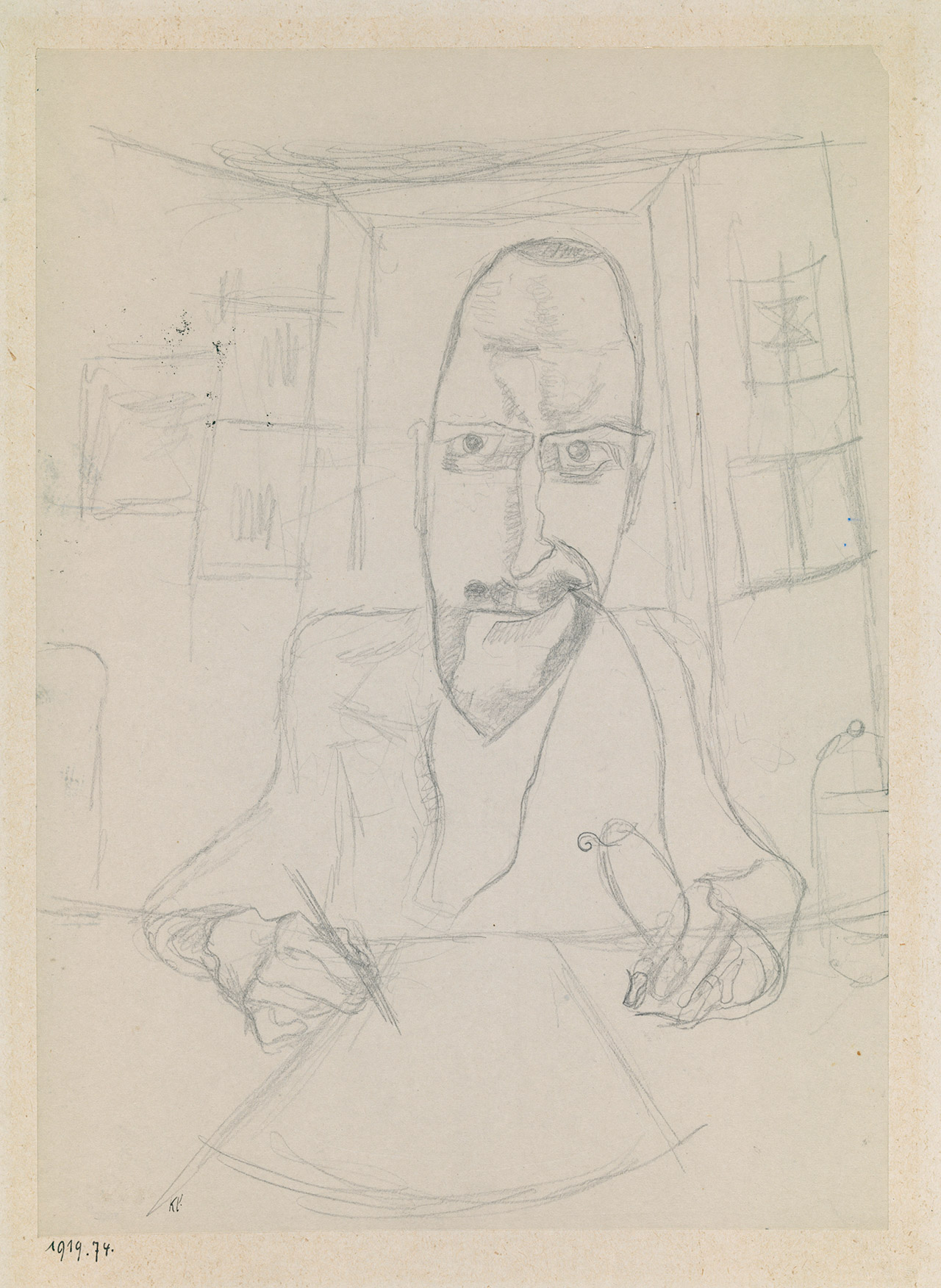
Pencil on paper on cardboard Zentrum Paul Klee, Bern Donation of Livia Klee Creating Artist, 1919, 74 pencil on paper on cardboard 27,2 x 19,5 cm Zentrum Paul Klee, Berna [Bern] Donation of Livia Klee It is no surprise that a whole series of self-portraits appeared in Paul Klee’s work in 1919. At the age of forty, finally, Klee is successful and a well-known artist. He was able to show his works in exhibitions and even sell some works, and he had a sole agency contract with a Munich gallery. In the same year he moved into his first real studio in the rather dilapidated little castle of Suresnes in Munich, just around the corner from his apartment. It was also his most productive year so far, and his son Felix wrote: "wrapped up in his own world Klee lived only for his art, serving it from the earliest hours of the morning until midnight." Klee had previously used self-portraits to engage with himself and above all with his sense of himself as an artist. Sometimes he portrayed himself as a melancholic, sometimes as a thinker, sometimes as an introverted visionary artist. Among the work numbers from 71 to 74 from 1919 Klee drew four self-portraits. He is sitting at a desk, with a window behind him and walls covered with paintings. Klee depicts himself as a thinking, feeling, reflecting artist, shaping his work – so during the preparation for composition and not, as is usually the case in art history, as a painting artist at the easel. Sometimes Klee is easily recognisable, but the drawings tend to be caricatures of himself, with a slightly deformed skull, for example. As early as 1905 Klee said: "If I were to paint an entirely true self-portrait one would see a curious bowl. And in it, should be made to understand, would be myself, like the kernel in a nut."
Young Proletarian (Junger Proletarier)
Paul Klee

Oil on cardboard 24,4 x 22,7 cm Zentrum Paul Klee, Bern Donation of Livia Klee Young Proletarian, 1919, 111 oil on cardboard 24,4 x 22,7 cm Zentrum Paul Klee, Berna [Bern] Donation of Livia Klee In dark tones, in oil paint on card, Klee paints the portrait of a young proletarian. The whole painting is executed in powerful, dynamic brushstrokes which describe the forms of the figure rather than precisely depicting it. What is interesting is the colouration of the work: what at first glance evokes a gloomy mood is on closer examination developed out of bright, colourful cross-hatching in red, green, yellow and blue. The blue eyes are particularly striking, but so are the traces of blue on the proletarian’s ears. The drawing of the face, of nose, mouth, eyes and the wrinkles above the eyes, gleams in white from the gloomy ground of the painting. Light seems to fall on the right-hand side of the proletarian’s jacket. This work is one of the few paintings in Klee’s oeuvre in which he engages directly with the social and political conditions of his time. Shortly after the First World War the German Kaiser stood down, and in April 1919 the Bavarian Society Republic was declared. Klee also took sides by taking part in the Revolutionary Artists’ Auction Committee. After the defeat of the Soviet Republic Klee settled briefly in Switzerland, as he feared arrest. With the portrait of the young proletarian with the gloomy expression in his wide open eyes, Klee seems to be giving expression to these events. Throughout his whole career Klee painted portraits and addressed the question of the human physiognomy, beginning with studies during his time at Heinrich Knirr’s private drawing school, via cartoon-like depictions after his training in Munich around the turn of the century, to an even more intense engagement with the form in the 1930s. In most cases Klee tries to depict character traits, qualities or types, pared down to their essentials.
Paths to Abstraction
Paul Klee

Upon analyzing the work of Wassily Kandinsky, cubism, and the orphism of Robert Delaunay, the question of pictorial abstraction became a central theme for Paul Klee during the 1910s. Besides architecture, nature also served as a model for Klee’s abstract language. In this sense, his gaze shifted from the exterior to the interior of the object. He stated: “Art does not reproduce the visible, it makes visible.” He was convinced that he should represent the structure and construction inherent to nature and architecture. Inspired by the color-field style of Delaunay, whom he visited in his Parisian studio, and based on impressions he experienced during his trip to Tunisia in 1914, Klee became a master in working with color.
In the Houses of St. Germain (In den Häusern v. St. Germain)
Paul Klee

15,5 x 15,9/16,3 cm Zentrum Paul Klee, Bern Donation of Livia Klee In the Houses of St. Germain, 1914, 110 watercolour on paper on cardboard 15,5 x 15,9/16,3 cm Zentrum Paul Klee, Bern Donation of Livia Klee Journey to Tunisia The journey to Tunisia, which the three artist friends Paul Klee, Louis Moilliet and August Macke undertook in April 1914, counts as one of the milestones of 20th century art history. It was principally thanks to Louis Moilliet that this journey took place at all. Louis Moilliet was a school friend of Paul Klee’s and their paths crossed repeatedly after their school days. Moilliet knew August Macke’s wife, who had worked in Moilliet’s mother’s boarding house and she introduced him to her husband on their honeymoon in Bern in 1909. Moilliet and Macke quickly became friends. Finally, Louis Moilliet knew the married couple Jaeggi in Tunis, doctors from Bern, by whom he enjoyed practically open house, and since 1907 often visited. In 1911 Paul Klee and August Macke met for the first time at Louis Moilliet’s house in Gunten on the Lake of Thun. During the 1913/14 Christmas holidays which the Klees spent in Bern, the three artists met in Hilterfingen, where the Macke family were living for several months. Here the three friends planned a journey to Tunisia. The suggestion seems to have come from Klee. Finance was a problem for all three of them, as they were all dependent on the support of patrons. Through Moilliet’s connections Paul Klee was able to sell Fr. 500 worth of pictures to a pharmacist in Bern. On the 3rd of April 1914 Paul Klee arrived in Bern with his six year old son Felix. Since his wife Lily Klee was working professionally and was unable to take care of the boy during Klee’s absence, he was brought to his grand parents. Two days later, Klee and Moilliet left Bern and travelled by train to Marseille where they met Macke. On the evening of the 7th of April the „Carthage“ embarked on a three-hour, relatively choppy crossing to Tunis habour, where Klee was struck by the clarity of the colours from the first moment. The three of them spent the following days together with Jaeggis in Tunis and St. Germaine. On the 14th of April they travelled further to Hammamet and on the next day to Kairouan. For Klee Kairouan represented both the goal and the peak of the journey. The experiences overwhelmed him so much that he decided to return to Tunis again on 17th of April. He reached Europe again by 19th of April while Macke and Moilliet remained for a few more days. On 22nd of April Klee arrived back in Bern from Naples. On this journey, August Macke painted the most. Beside around 50 water colours he did many drawings as well. Klee entered about 50 items in his Catalogue of Works including water colours, pencil and ink drawings. Moilliet appears to have only finished three water colours and five drawings. For Klee the journey to Tunisia was the most important turning point in his artistic development. For Macke it was both climax and finale: five months later, he fell in the First World War. Later Moilliet travelled frequently back to North Africa.
Composition with Windows (Komposition mit Fenstern)
Paul Klee

Oil and pen on cardboard; Original frame 50,4 x 38,3 cm Zentrum Paul Klee, Bern Donation of Livia Klee Composition with Windows, 1919, 156 oil and pen on cardboard; original frame 50,4 x 38,3 cm Zentrum Paul Klee, Bern Donation of Livia Klee The painting Composition with windows from 1919 shows how closely nature and construction as well as object and abstraction are in Paul Klee’s thought and work. For example, in his writings Klee speaks of "pictorial architecture", meaning that a picture is organised according to certain ordering principles and structures, as in a piece of architecture. Some of Klee’s pictorial structures can even be traced back to concrete numerical relations. But Klee’s pictorial compositions are just as close to nature and humanity as they are to architecture. "Pictures", he wrote, "have their skeleton, muscles and skin like human beings. One may speak of the specific anatomy of the picture. A picture representing ‘a naked person’ must not be created by the laws of human anatomy, but only those of compositional anatomy. First one builds an armature on which the picture is to be constructed. How far one goes beyond this armature is a matter of choice; an artistic effect can proceed from the armature, a deeper one than from the surface alone." In this picture, a grid-shaped structure partly consisting of black lines at right-angles, forms the "skeleton". The grid of lines is still partially visible under the next layer of painting. In several stages of the work Klee painted over this structure with red, green, white and black patches of paint, thus creating a varied play of different colours and different tonal shades from light to dark. Over this Klee laid simple forms for windows or plants through to cross and star shapes and the letter "B". On the reverse of the painting Klee noted "not for sale meant for the collection of the estate". Accordingly, the work never entered the art market. Instead, for Klee it was part of a representative selection of his work, which he kept to himself. At the same time Klee placed the painting in the highest of his price classes, class XVIII.
The World as a Stage
Paul Klee

Paul Klee was a passionate spectator of theater – in everything from opera to popular puppet theater. Characters from musicals and other dramatic plays, as well as the clown, the puppet or the acrobat populated his enigmatic imagination. Klee made constant associations between theater and life. His depictions of characters such as the tightrope walker and the acrobat, for example, with their daring balancing acts, constantly at risk, resembled how the artist’s own life was also insecure. As a theater spectator, Klee observed the people around him and commented on them in his artworks, nearly always from an ironic and distanced viewpoint. His son Felix, who later became an opera director, could also represent life at the Bauhaus in a playful and ironic way. Using the puppets created by his father and a stage that he himself built in the carpentry workshop, Felix staged stories for friends and family about the daily life at the school where his father taught.
With the Puppet (mit der Marionette)
Paul Klee

Oil and brush on primed gauze on cardboard 37,5 x 32 cm Zentrum Paul Klee, Bern Donation of Livia Klee With the Puppet, 1919, 159 oil and brush on primed gauze on cardboard 37,5 x 32 cm Zentrum Paul Klee, Bern Donation of Livia Klee Klee and Theatre Klee was an inveterate theatregoer and devotee of all things staged. He adored opera, operetta and plays as much as he did the more humble, less rarefied art forms such as puppet and marionette theatre, the circus, the music hall and the kind of popular theatricals you find at carnivals and annual fairs. The performing arts as a whole, role-playing and the world of figurines exerted a lifelong fascination over him. The link Klee forged between theatre and life, though, assumed a wider dimension: drama for him was not something that happened exclusively in a playhouse or circus big top – it was very much part of his day-to-day life. Klee’s observation of the world and of life was that of a theatregoer. The people around him were the actors, the daily occurrences the plays; he personally took upon himself the role of spectator, observing all the goings-on at a safe distance as if through opera glasses. Theatre in all its guises can be seen pervading a substantial part of Klee’s body of work. Role-play even entered his self-portraits, and he experimented with a number of different ways of depicting himself. His keen eye for theatrical situations led him to discover traits of human role-play even in the behaviour of animals. He watched the antics of cats and dogs trying to attract attention. He even enframed landscapes with stage curtains and portrayed plants as actors on an imaginary stage. Masks and figurines were important leitmotifs for Klee and inspired him throughout his career. The concept of duality in mask play and the mechanics involved in marionette theatre were a source of critique, yet also of fascination. Klee, too, explored in his works the modernist experimental theatre of the Bauhaus in Weimar and Dessau. We know that he was sceptical of what he called its “cut and dried spectacles”, yet this did not stop him integrating a number of elements from its visual language in his work. The circus with its animal acts and clowns, but especially its acrobats and aerial artists, held Klee in particular thrall. He saw them as mirroring his own existence as an artist. Above all, he found the tightrope walkers a never-ending source of inspiration. Their balancing act on the high wire was for him a metaphor for the artist risking all between success and failure, triumph and catastrophe. Klee would also regularly trot out comic characters from the worlds of opera, film or the street – his repertoire included Falstaff, Chaplin, Harlequin and the Clown. His fools are often seen moving between comedy and solemnity, or are depicted challenging their traditional role clichés.
Tightrope Walker (Seiltänzer)
Paul Klee

Lithograph 43,2 x 26,8 cm Zentrum Paul Klee, Bern Tightrope Walker, 1923, 138 lithograph 43,2 x 26,8 cm Zentrum Paul Klee, Bern A small acrobat balances high in the air on a rope. The construction, upon which the rope is held taught, appears very flimsy. A small change of tension would be enough to make the rope sway and the small acrobat would be in danger. The situation can certainly be interpreted autobiographically, in that we recognise Paul Klee as the tight-rope walker, and in the fragile construction, the power relationships at the Bauhaus. The artistic and idealistic orientation of the Bauhaus was characterised by violent conflicts and fluctuating power structures. The geometric structure of the fragile frame could be interpreted as the influence of the constructivists - the face in profile as the influence of Oskar Schlemmer, analogous to the Bauhaus logo he had created. And over all these conflicts stands the artist Paul Klee, who does not want either himself or his art to be involved but who must constantly reorientate himself and find the balance between the currently dominant forces. The cross, leaning slightly to the left in the background, underlines the fragility of his situation. Klee described his Tight-rope walker as the «most extreme realisation of the symbol of the balance of forces». The tight-rope walker achieves equilibrium on the fragile, swaying balance by means of a balance pole. Klee noted this in his Pictorial Morphology: «The feeling of the vertical is alive in all of us, so that we don’t fall and when necessary, we stretch our arms out in correction and equalise the mistake. In special cirmcumstances we extend the horizontal like the tight-rope walker with a balancing pole.» With the profile of a human head which can be made out in the midst of the fragile construction, Klee makes clear that he understands balance not just as a physical but also as a psychic tight-rope walk. From the tight-rope walker, drawings as well as water-colours and un-coloured oil phase pictures have been preserved. In addition Klee had the picture reproduced as a lithograph.
Genii - Figures from a Ballet (Genien - Figuren aus einem Ballett)
Paul Klee

Pen, watercolour and pencil on paper on cardboard 24 x 16,4/15,9 cm Zentrum Paul Klee, Bern Genii (Figures from a Ballet), 1922, 122 Pen, watercolour and pencil on paper on card 24 x 16,4/15,9 cm Zentrum Paul Klee, Bern The word "Genius" quoted by Paul Klee in the title of the work refers to the protecting spirits in ancient Roman religion. In every man – and only in men – there dwells a genius that dies with him. The genius represents the personality and the capacity for procreation. This also gives rise to the word "genius", which we use today to refer to the creative force, the source of inspiration or a particularly gifted person. The two figures in the watercolour Genii (Figures from a Ballet), painted in 1922, are easily recognisable as two female dancers. The attitude of the legs and the outstretched arms which look almost like wings leave no doubt about it. We should also look at the magical composition of the figures: the larger one has radiantly blue eyes, a charming torso and nimble little shoes; the smaller wears a white skirt, and her face is shaped almost like a treble clef. But Klee doesn’t only depict two dancers in motion. In fact he tries to use all the other means at his disposal, such as line, form and colour, to accentuate the dynamism of the scene. The outline shapes of the two figures are repeated like an echo. As if various different moments of a movement were being captured, as was often done in Italian Futurism. At the same time Klee changes the initially colour to darker shades towards the edge of the picture. He also picks up the shading of the colour tone in the outline shapes at the bottom edge of the picture. Here the colour moves from dark tones at the top to an almost white colour right at the bottom. As a result Klee produces an impression of space and imitates a scene on a stage in which the dancers are brightly lit by floodlights and the background remains in darkness.
Replica of the hand puppet (Replik der Handpuppe)
Paul Klee
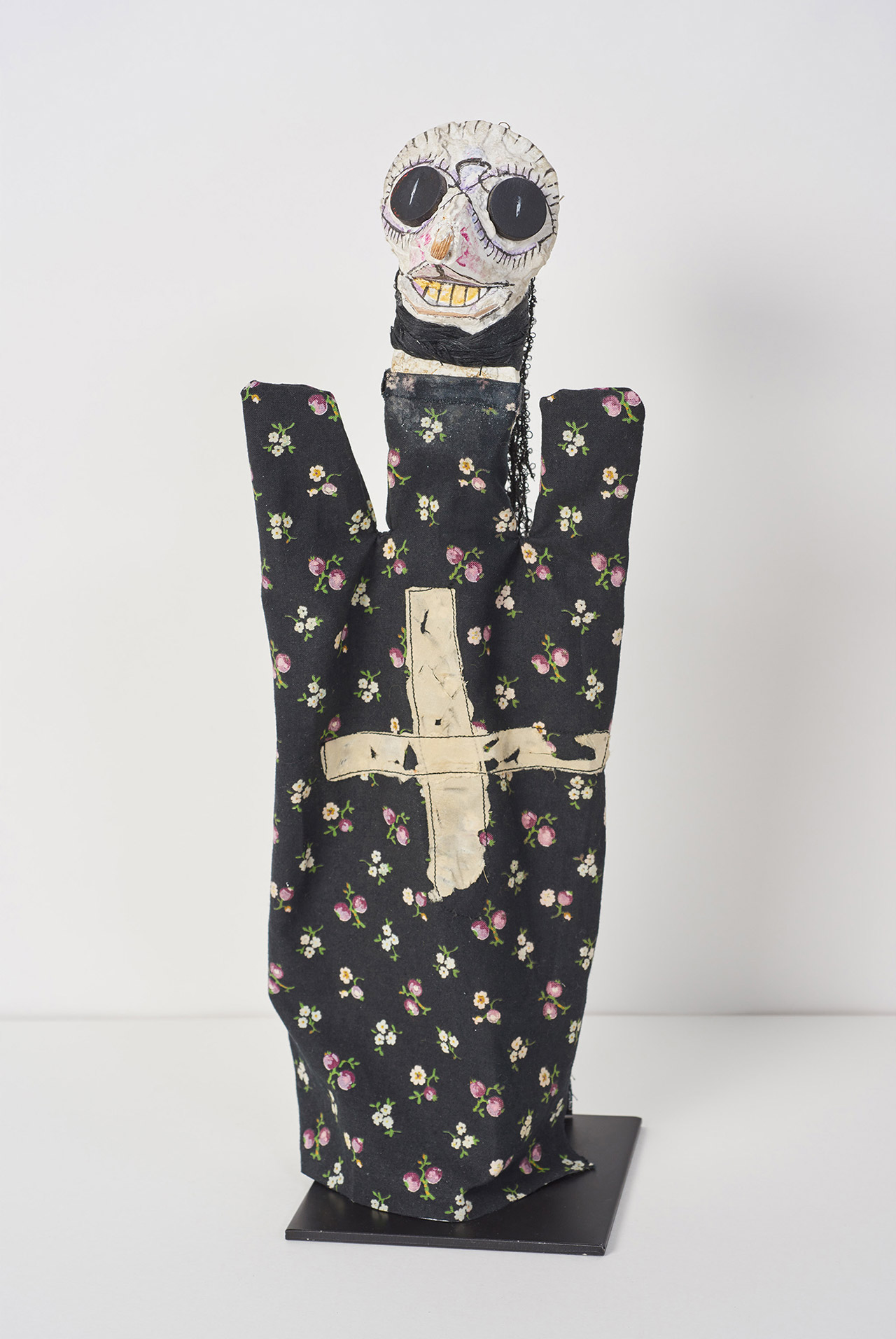


Replica of the hand puppet - Self-portrait hand puppet 37 x 23 x 14 cm Zentrum Paul Klee, Bern Replica of the hand puppet - Big-Eared Clown hand puppet 48,5 x 17 x 13,2 cm Zentrum Paul Klee, Bern Replica of the hand puppet - Ghost of a Scarecrow hand puppet 44 x 15 x 11 cm Zentrum Paul Klee, Bern Replica of the hand puppet - Crowned Poet hand puppet 36 x 17 x 13 cm Zentrum Paul Klee, Bern Replica of the hand puppet - Electrical Spook hand puppet 36 x 15 x 9 cm Zentrum Paul Klee, Bern Replica of the hand puppet “Self-portrait” hand puppet 37 x 23 x 14 cm Zentrum Paul Klee, Bern Replica of the hand puppet Big-Eared Clown hand puppet 48,5 x 17 x 13,2 cm Zentrum Paul Klee, Bern Replica of the hand puppet Ghost of a Scarecrow hand puppet 44 x 15 x 11 cm Zentrum Paul Klee, Bern Replica of the hand puppet Crowned Poet hand puppet 36 x 17 x 13 cm Zentrum Paul Klee, Bern Replica of the hand puppet Electrical Spook hand puppet 36 x 15 x 9 cm Zentrum Paul Klee, Bern Glove puppets general Between 1916 and 1925 Paul Klee made puppets for his son Felix from various kinds of materials. Altogether about 50 glove puppets were made, of which 30 have been preserved. Paul Klee made them as toys for his son and they always remained in the family’s possession, were never up for sale and never recorded by the artist in his handwritten Œuvre Catalogue. The puppets are mixed beings, products on the border between artistic handwork and toys. For the realisation of the heads and costumes Klee initially restricted himself to plaster and simple cloth from his wife’s sewing basket. With time however he extended his »palette« to include all materials imaginable. Cotton cloth with different patterns, linen, silk, velvet, Manchester corduroy and leather were used. For the heads he used cow bones and nut shells, rabbit fur and real hair bristle, match boxes and even an electric socket. As a rule Klee sewed the clothes himself - only the very first costume he allowed to be tailored by Sasha von Sinner - the maker of the now famous Sasha dolls. The first stage set consisted of a combination of illustrations, which Klee had taken from the »The Blue Rider« almanach. The theatre, made out of old picture frames and pieces of cloth, remained together with the stage backgrounds and decorations in Weimar. The puppets were made in several groups. The first set of presumably eight figures Felix received on his ninth birthday on 30th November 1916. These figures apparently made up the cast of the classical fairground theatre: Punch, Judy, the devil, the crocodile and policeman. Unfortunately only one of these is preserved. In the year 1919 the second set followed after an interval caused by the war. From then on more new figures were added each year. Today the puppets are art historical objects and are in the possession of the museum, where they are preserved and included amongst the objects of academic interest. Nevertheless it should not be forgotten that they were not actually intended as works of art for a large public. „Hanging onto my father’s coat-tails, I – Felix - accompanied him on all errands. Often it was only shopping or other excursions, for instance in the nearby English Garden or twice a year to the Auer Dult fair. While making these purchases, he delivered me to the puppet theatre playing there. The original Bavarian performance awakened in me the urgent wish to also own and perform something similar. This childhood wish animated my father so much that in the year 1916, he made me some glove puppets and built a theatre to go with them.“ (Quote Felix Klee)
Magic Theatre (Zaubertheater)
Paul Klee

Pen, brush and watercolour on paper on cardboard 30,6/31 x 21,2/21,7 cm Zentrum Paul Klee, Bern Magic Theatre, 1923, 25 pen, brush and watercolour on paper on cardboard 30,6/31 x 21,2/21,7 cm Zentrum Paul Klee, Bern A powerful magician conjures up a thoroughly unreal world in »Magic theatre« which is doubly unreal: as theatre with its own version of reality on stage, and as scenes conjured up by magic. The creatures dressed as people are not only actors; they cannot in any way be reconciled with our conventional view of reality, either. It is a world governed by alternative laws of nature. Gravity is suspended, leaving everything floating in space. A peculiar creature is entering stage left, characterised by huge ears and non-matched eyes that are fixed on us. Its body is pig-like, and its head could be that of a cat licking its mouth. Stars, the moon and a bolt of lightning accompany its arrival. The centre of the composition is occupied by an unprepossessing figure whose form, apart from its head and hands, is difficult to make out. In several places, its body is covered by shapes and figures. The way its head and the head of the aforementioned creature interconnect is clearly visible. The eyes of the large central figure in »Magic theatre« are only hinted at. Only its beard and nose are clearly visible by virtue of the light grey used. A dragon-like creature with sharp teeth and a wide-open mouth can be seen lower left. Its head is in profile, with its body turned toward the beholder. On its nose, this fantastical apparition is balancing a bent pole, at the end of which is a wheel. A little man with upraised arms is sitting astride this pole: he seems to be directing operations. Behind him is yet another figure with a cross on its breast – this one is learning how to balance. It also has its arms upraised and is holding a teardrop-shaped object and a form of boat or flower in its hands. To its right, a one-eyed animal is standing on a small table. It is the only figure in the picture to have a human eye. Everything appears to be in movement in this drawing, which has been executed with pen and brush in a manner reminiscent of the Old Masters. One feels that the elements of the picture could at any moment transmogrify into new figures. In Paul Klee’s work, animals often take on plant-like forms, while plants change into animal-like apparitions. Klee digs deep into nature’s treasure trove of shapes to come up with his own creations, none of which can, with any certainty, be classified as either purely botanical or purely zoological. Paul Klee’s constantly varying fantasy world places him in the same area as the Surrealist movement that emerged in Paris in 1920. Yet he did not want to join the group, which had at its head the authoritarian André Breton. Klee continued to pursue his own path, remaining sole creator of his own theatrical world.
Professor at the Bauhaus
Paul Klee

From 1921 onward, Klee began to teach the theory of form in the basic core course of the Bauhaus at its initial location in Weimar, and later, starting in 1926, at its new location in Dessau, both in Germany. He was mainly interested in teaching his students a “living configuration.” In the first semesters, his strategy was to point to the natural processes of growth. Later he used this knowledge of nature to work on questions linked to geometry. Klee also knew how to productively apply the theory of planimetric and stereometric configuration in his own work. In 1931 there arose various series of drawings of constructions, made with geometric lines, based on models that he made with wooden sticks, rubber bands and threads. Klee would produce up to fifteen variations of a single model. He played with the shapes, bending, projecting, distorting and twisting them. In his drawings of a constructivist character, he also resorted to these models as the basis for narrative themes.
Steerable Grandfather (Lenkbarer Grossvater)
Paul Klee

Pen on paper on cardboard 60,3/ 59,6 x 46,2/ 46,5 cm Zentrum Paul Klee, Bern Steerable Grandfather, 1930, 252 pen on paper on cardboard 60,3/ 59,6 x 46,2/ 46,5 cm Zentrum Paul Klee, Bern The Bauhaus The State Bauhaus was founded in Weimar in 1919. The very first programme of the Bauhaus revealed the institution’s twin priorities: on the one hand artists were to go back to craft skills, so that they could involve themselves in construction, the goal of their training. On the other hand artists were described as an intensification of the craftsman. The term "Bauhaus" referred to the mediaeval building workshops, in which all craftsmen worked together in a social and intellectual community. Alongside construction the other goal of the teaching was the production of industrially manufactured goods, whose form fulfilled artistic criteria. In order to convey these basic principles, Walter Gropius, the founder of the school, brought painters and sculptors to the Bauhaus. As so-called "form masters", they gave theoretical instructions, while the "work masters", the leaders of the workshops, were responsible for practical training. Aside from this division into theoretical formal training and practical work training, a preparatory course was one of the school’s most lasting innovations. In the preparatory course, the practical part of the basic course introduced by Johannes Itten, various materials such as wood, raffia, glass and metal were investigated for their unique properties, and used in combination. Apart from Paul Klee, the other teachers on the formal training programme included the painters Lyonel Feininger, Oskar Schlemmer and Wassily Kandinsky. Because of hostility from right-wing forces in Weimar, in 1925 the Bauhaus moved to Dessau, where a new school building as well as houses for the teachers were built. When the Swiss architect Hannes Meyer became the new head of the Bauhaus in 1928, the direction of the school became even more purpose-oriented than before. In the summer of 1930, after Meyer was dismissed without notice, the architect Mies van der Rohe became head of the school. In 1932 the school moved to Berlin for the last year of its existence. A year later the Nazis forced the Bauhaus to close down.
Harmony of the Northern Flor (Harmonie der nördlichen Flora)
Paul Klee

Oil on primed cardboard on plywood; Original frame 41x 66/66,5 cm Zentrum Paul Klee, Bern Donation of Livia Klee Harmonie der nördlichen Flora, 1927, 144 Harmony of the northern flora oil on primed cardboard on plywood; original frame 51,6 x 77,2 x 6,7 cm Zentrum Paul Klee, Bern, Schenkung Livia Klee The oil painting » Harmony of the northern flora «, belongs to what are known as the »square pictures« that Paul Klee worked on at the Bauhaus in Weimar, and that he systemised during his time in Dessau from 1925 onwards. More than ten years prior to this he had composed the first watercolours using geometrically arranged tiles of colour. The »square pictures« are testimonies to Klee’s methodical study of colour theory, where le looks, for instance, into the complementary relationship of the colour circle and colour sphere and into their contrasts of colours. The Dutch De Stijl artist Theo van Doesburg, who held courses in Weimar in 1922/1923, provided important stimuli for the deepening interest evinced by Klee and other Bauhaus artists in the analysis of colours as pictorial means of production. The primary colour yellow dominates in the rectangular grid of » Harmony of the northern flora «, while red only appears as a blend; blue, the third primary, does not appear at all. In contrast to the primaries, the complementary colours orange, green and purple are fully represented, the latter – as a complement to yellow – showing the most variation. The tones cool down, becoming lighter and greyer as they near the edges of the picture – a process that Klee, in the title » Harmony of the northern flora «, relates to the experiencing of nature with the senses.
The Step (Der Schritt)
Paul Klee

Oil and pencil on burlap 71 x 55,5 cm Zentrum Paul Klee, Bern Donation of Livia Klee The Step, 1932, 319 Oil paint and pencil on jute 71 x 55,5 cm Zentrum Paul Klee, Bern, gift from Livia Klee In the notes for his teaching at the Bauhaus, Paul Klee speaks of freedom of thought. The mind is not alone in the world, however, as Klee notices, but bound up with a body. And this is in turn bound by gravity to the earth. The body does not have the same possibilities of movement as the mind does. In creeping, striding, climbing steps or even jumping, it remains subject to the laws of gravity – of the plumbline, as Klee calls it. What Klee analyses in detail in reference to movement in his teaching notes, mostly at a theoretical level, he tries to transpose into practice in his paintings – often in a free and playful way. He tries to depict in visual terms the physical experience of the walking posture, the rhythm of striding or the search for balance. Even in its title, the painting The Step from 1932 refers to the thematic area of motion. The depiction is as clear and reduced as the title: a cross-shaped geometrical figure with two black circles for the eyes and short lines for the legs; a long red line cuts through the painting. Klee shows the movement and the direction of the movement very simply with the physical posture, the direction of the gaze and the alignment of the feet. But inconspicuous details further reinforce the impression of movement: Klee paints the right arm and the triangle near the right leg bigger than the corresponding planes on the left. This weights the picture in the direction of the movement, which the figure balances with the posture of its back. Klee reduces the clumsy and monumental aspect of the figure – its heaviness – by standing it on thin little legs. Klee also uses the plane that he has placed in the middle above the body of the figure to make the figure look lighter. In his notes Klee uses the expression "heavylight", which clearly demonstrates his tendency to make use of contrasting things, as he does in the painting The Step. Finally, the red line depicts a kind of lightning flash. Klee repeatedly uses the arrow or the lightning flash as a symbol of dynamism. In this painting too the lightning flash should be seen less as a motif and more as an expression of movement.
Drawing Reality
Paul Klee

When the National Socialists came into power, Germany underwent drastic upheavals. In 1931, Klee transferred from the Bauhaus to the Düsseldorf Art Academy. In letters to his wife, he commented on the political reality. He hated Hitler, his primitive demagogy and populist greed for power. He commented on the “National Socialist revolution” with vigorous lines in a series of 250 figurative drawings in pencil. Although there are few direct references to National Socialism in the titles of his illustrations from 1932 in 1933, Klee nonetheless alluded to the violent and threatening atmosphere, which at Christmas 1933 forced him to emigrate to Switzerland.
Struck from The List (Von der Liste gestrichen)
Paul Klee

Oil on paper on cardboard 31,5 x 24 cm Zentrum Paul Klee, Bern Donation of Livia Klee Struck from The List, 1933, 424 oil on paper on cardboard 31,5 x 24 cm Zentrum Paul Klee, Bern, Donation of Livia Klee The picture Taken off the list is a self-portrait in dark colours showing Paul Klee with closed eyes and tightly shut mouth with the corners drawn downwards. Over this a large X is drawn with two thick brush strokes - an unmistakable sign for the act of dismissal, and the feeling of deletion and extinction. The face reduced to schematic areas of colour has a frozen affect and the branding with the black cross implies the stamp of censorship and destruction. The substance of the picture corresponds to the effect, in the crudeness of the slapped on appearance of the faded colour paint. This self-portrait was one of the last pictures created in Germany, directly before Klee’s emigration to Switzerland. Paul Klee returned to Berne, the city of his childhood and youth, on the 23rd December 1933. This was not done willingly, but was the enforced reaction to the accession to power by the National Socialists in Germany. From the beginning Paul and Lily Klee had observed the developments in Germany with unease. In Weimar and Dessau they were forced to experience the ugliest attacks on the Bauhaus by the National Socialists. In the spring of 1933 Paul Klee was personally the object of attacks: on the 1st April the Düsseldorf Peoples’ Voice, the official National Socialist daily newspaper, stirred against the liberal State Art Academy and focussed its insults on Klee. „Then comes the great Klee, famous already as professor at the Bauhaus in Dessau. He tells everybody he has Arabian blood whereas he is a typical Galician Jew.“ On the 21st of April Klee was given leave with immediate effect from all his teaching duties at the Academy. In the autumn followed the definite dismissal for the end of the year with the words „Professor Klee is considered a Jew and as a teacher, unacceptable and unnecessary.“ In the 1920’s Paul Klee had already encountered rejection amongst conservative circles with regard to his art. The claim that Klee was a Jew, was false but offered the new regime at that time the opportunity to defame Klee, ruining him financially and artistically. After his leave, Klee withdrew progressively back into his own work so that in this year, with 482 works created, he produced more than in the years before. In many works he analysed the events around him directly and portrayed his fears and disappointments. One group of works consisted of over 200 quickly sketched drawings on subjects like upbringing, authority, militarism, humiliation, escape and unconsciousness. Besides these, for the most part sinister paintings were created - commenting on the political turmoil in Germany.
Angels and other beings
Paul Klee

In his pictorial worlds represented in multiple layers, Klee combined various spheres of reality and abstraction. He thus enlarged his imagination to also include a wide range of different sorts of creatures. Since 1920, the theme of the angel – a winged, anthropomorphic, celestial figure – appears repeatedly in his work. His most famous angel, Angelus Novus, 1920, was acquired by philosopher Walter Benjamin, who described it as the “angel of history,” who looks with dismay at the catastrophe of the past. Beginning in 1938, Klee created a standalone series of more than 40 depictions of angels. In them, the artist blended human and superhuman features, defining them in the titles as incomplete, ugly or forgotten. In this field of existential transition between the human and the supernatural, the complete angelic state had not yet been reached.
Forgetful Angel (Vergesslicher Engel)
Paul Klee

Pencil on paper on cardboard 29,5 x 21 cm Zentrum Paul Klee, Bern Forgetful Angel, 1939, 880 pencil on paper on cardboard 29,5 x 21 cm Zentrum Paul Klee, Bern Paul Klee drew this "Forgetful angel" in 1939 with very few pencil lines. It is one of over 35 depictions of angels from the last years of the artist’s life and work. In their appearance they correspond entirely to our traditional ideas of gentle, winged creatures, even though Klee reduces the wings to shapes narrowing to points and also sometimes makes the creatures ugly. But Klee’s angels are not figures of light or heavenly Christian creatures like those known to art history for hundreds if not thousands of years. His angels are rather more with us than in a heavenly sphere, somewhere in an intermediate world. They have become human and Klee tends to use them to refer to all the human moods, characteristics and qualities. Klee addresses our good sides every bit as much as our shortcomings. Often the angels have something childish and innocent about them, they are not quite complete or are still in training. Klee does not resolve the question of where that training and development might lead. In his "Compositional Theory" Klee says at one point: "Man is not complete. One must continue to develop, be open, be an elevated child in life too, a child of creation, of the creator." The "Forgetful angel" is one of the most expressive and magical angels in Klee’s work. He draws the angel’s face with three lines: its eyes, closed or downcast, and its small mouth. Klee needs nothing more to give the angel a gentle, tender expression. Its hands are folded, as if it were rubbing them together slightly embarrassed.
Late Works
Paul Klee

Paul Klee’s last creative phase was marked by his state of health, which became increasingly precarious. In late 1935, Klee contracted scleroderma, a rare autoimmune disease, which hardens the connective tissues, the skin, and sometimes the internal organs. Nevertheless, in the last years of his life he created multifaceted and rich work, characterized by daring freedom from the models of composition and the configuration of form. As a result, the artist made drawings using the brush with intense gestural spontaneity, with an archaic visual language, partly reminiscent of the finger paintings of children. In relation to the content of these works, this technical “simplification” corresponded to a playful enjoyment of the grotesque.
Untitled "Last still life" (Ohne Titel "Letztes Stilleben")
Paul Klee

Oil on canvas 100 x 80,5 cm Zentrum Paul Klee, Berna Donation of Livia Klee Untitled (Last still life), 1940 oil on canvas 100 x 80,5 cm Zentrum Paul Klee, Bern Donation of Livia Klee Late work after 1937 At the end of February 1937 Paul Klee was finally able to work again after the long interval caused by his illness. With enormous energy and the highest concentration he made a new start both formally as well as quantitatively. His productivity increased continuously and peaked in 1939 with 1254 works, an absolute record. His uncertainties and disappointments of the past years were overcome. Although Klee never commented on his illness in his painting, his work after 1937 is fundamentally different from all he previously created. The greatest sizes and the brightest colour format and a more marked symbolic language form characterise his late work. The forms become more simple and appear as forceful shapes out of clear, often black lines or stripes which are combined with shining bright areas of colour. Klee’s interest in technical experiments remains unbroken as may be recognised from the sometimes unusual materials and methods used. The choice of picture materials is constantly more varied. Numerous paintings are created upon porous material such as newspaper and sack cloth. Klee’s financial situation was tense and these cheap materials permitted him to be able to work in large dimensions. A significant portion of his late work consists of drawings. For it was however no longer important for Klee to achieve a refinement of his technical possibilities with delicate drawings. For health reasons alone, he was no longer in a state to do this, since his illness had led to a stiffening of his limbs and a huge reduction in the fine control of his gestures. Fewer expressively strong lines were formally better adapted to the communication of his sentiments and ideas.