
Aurora Imprevisível
Dawning
André Schütz
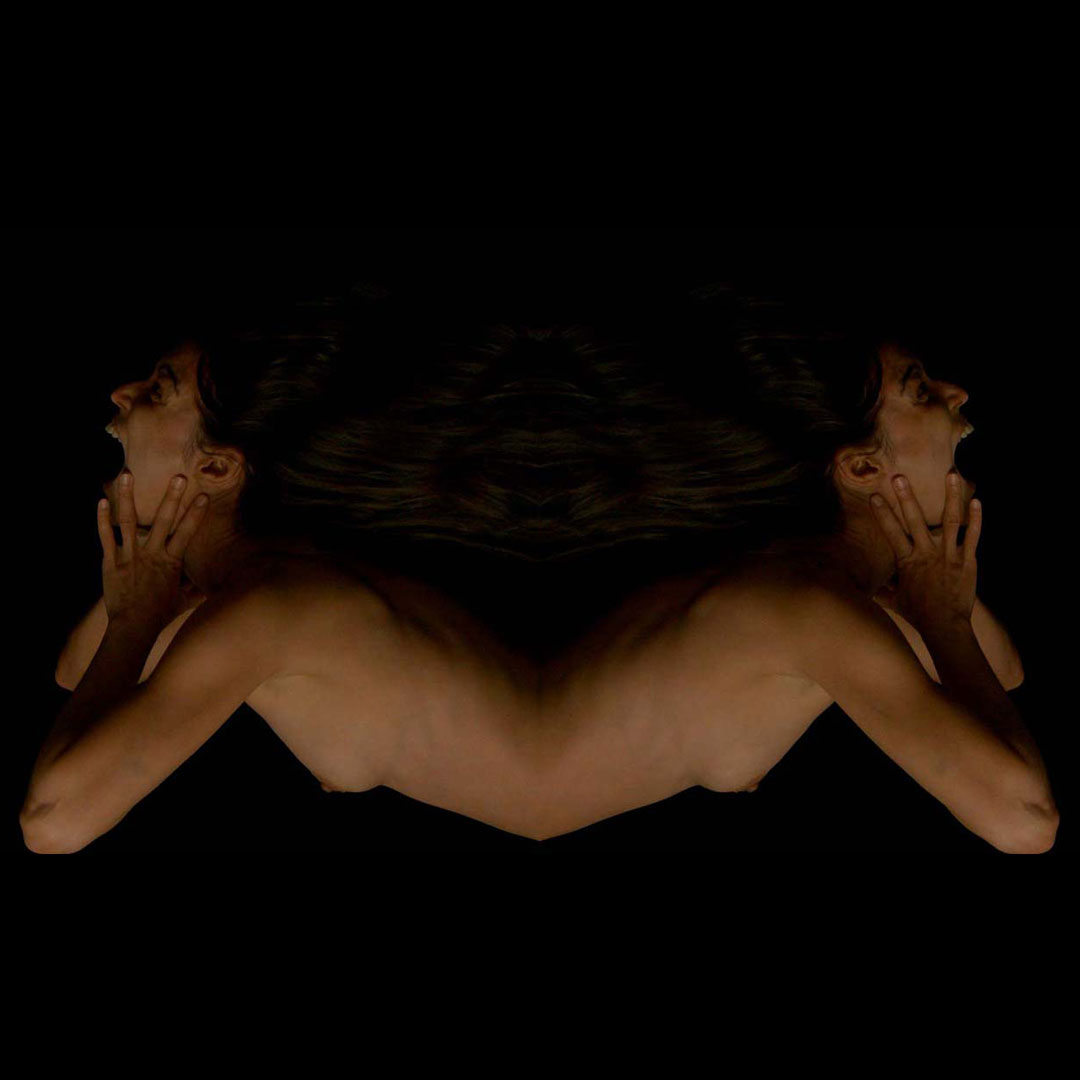


High definition video, 6'48 The movements of performer Karol Schittini draw the images in a continuous flow. Each gesture acts as a brushstroke in an oil painting, tracing new layers in the areas they run through and interfering with the previous layer in a cumulative way, sometimes as a mass, sometimes as a wash. What one sees is a body in the form that it is stored and transmitted, without the veil that creates the illusion of another object, like a language that reveals itself through its sound without translation. The piece is a video installation that uses the visitor's own device (smartphone or tablet) as support. The video can be viewed both vertically and horizontally, and the viewer is encouraged to play around with orientation during viewing by manipulating the position of the device. Dawning is part of the ongoing project Cup O’ Salt Tears, an investigation into corporeality and carnality in disembodied human interactions mediated by cameras and screens. This work was developed at the NET//WORK Residency 2, a partnership of The British Council, Digital Arts Studio (Belfast), Wising Arts Center (Cambridge) and Golden Thread Gallery (Belfast).
Nyctinasty
André Schütz


high definition video, 5'56 Nyctinasty is a type of nastic movement, like the opening and closing of some flowers, caused by external stimuli, such as changes in temperature or light intensity. In the video, the movements of performer Elisa Telles draw the images in a continuous flow. Each gesture acts as a brushstroke in an oil painting, tracing new layers in the areas they run through and interfering with the previous layer in a cumulative way, sometimes as a mass, sometimes as a wash. What one sees is a body in the form that it is stored and transmitted, without the veil that creates the illusion of another object, like a language that reveals itself through its sound without translation. The piece is a video installation that uses the visitor's own device (smartphone or tablet) as support. The video can be viewed both vertically and horizontally, and the viewer is encouraged to play around with orientation during viewing by manipulating the position of the device. Nyctinasty is part of the ongoing project Cup O’ Salt Tears, an investigation into corporeality and carnality in disembodied human interactions mediated by cameras and screens. This work was developed at the NET//WORK Residency 2, a partnership of The British Council, Digital Arts Studio (Belfast), Wising Arts Center (Cambridge) and Golden Thread Gallery (Belfast).
aquaRio
André Schütz
Cathode-ray tube, electronic components and standard resolution digital video (8' loop) 188 x 36 x 40cm aprox. In aquaRio, a cathode-ray tube takes on the role of a crystal amphora, like those at the Museu Paulista, which contains samples of water from the rivers that cross the Brazilian territory. But here, the content is not a static specimen, but a constant moving flow of electrons that draw the surface of the glass guided by an electromagnetic field. The gestures by performer Harun Aziz and the flight of a helicopter over Rio de Janeiro act as brushstrokes in an oil painting, tracing new layers in the areas they run through and interfering with the previous layer in a cumulative way, sometimes as a mass, sometimes as a wash. What one sees is body and landscape transforming and melting in the flow of movement. The aerial images, originally shot by biologist and activist Mário Moscatelli, show the disorderly occupation of the city of Rio de Janeiro and the degradation caused to the environment, particularly the impact on its waters (Jacarepaguá lagoon complex, Guanabara Bay, among others). aquaRio is part of the ongoing project Cup O’ Salt Tears, an investigation into corporeality and carnality in disembodied human interactions mediated by cameras and screens. This work was developed at the NET//WORK Residency 2, a partnership of The British Council, Digital Arts Studio (Belfast), Wising Arts Center (Cambridge) and Golden Thread Gallery (Belfast).
INTERNAL SILENCE
Beta Garcia
Sound Sculpture in Acrylic and Electronic Devices 180cm x 43cm x 30cm The sculpture "INTERNAL SILENCE" proposes a sound investigation as a representation of the non-possibility of silencing our minds, currently trapped in spaces where the only sounds are those of our own thoughts. A space of internal non-silence as a reflection of an external world. Made of black acrylic, the work tries to create an illusion of the exterior space around us as part of the internal space of the body and the mind. Reflections and thoughts cloistered in the artist's mind in a sensorial experience, expanding the sound out of the limits of the physicality of the work.
S1NAPS0S
Beta Garcia
Digital art in methacrylate 15cm x 20cm x 2cm The digital artwork "S1NAPS0S" proposes an imagetic organic neural representation interconnected to a digital network where it is impossible to identify who is in control; the worldwide computer's web or the neural networks that consist of each individual mind. The work in methacrylate has a tridimensionality that tries to escape from the current and excessive mediations through screens. A real physicality that confronts the virtual, leading the viewer's look to the digital that immerses us, represented in 0 and 1 bits.
Untitled
Bruno Marcelino


Acrylic and vinyl paint on wood frame and plywood board. 18,3cm x 14,2cm x 3,0 cm The work explores the intimate relation between panting and relief in art's history. Framing and space of the painting interpenetrate themselves, relating virtual shapes and tridimensional volumes. Painted elements are also reliefs, while the shadows meet the pictorial nature through their flatness. The corners of the frame, painted white, seem to delimitate the piece by highlighting its relationship of expansion with the white wall. Furthermore, the horizontal crossbeam painted on the background of the piece, from the centre to the left side, follows the thickness of the frame, thus reassuring the reunion, albeit fragmented, between the frontal plan and frame. This sort of horizontal trampoline finds, in the centre of the work, a painted square in subtle relief, composing a third layer, between the height of the frame and the deep and black plan. Therefore, the work takes place in layers perceived as material and layers perceived as virtual. The numbered of these layers starts, in its absolute, with the white wall itself, going through the shadow projected on it by the work, and then to the volumetry of the piece and the paint itself. The piece only demands the viewer's attentive look for these subtleties to be perceived.
Together
Bruno Marcelino
Galvanized steel and electrostatic painting. 120cm x 115cm x 50cm The work Together started to be built with the weaving of galvanized metal strips. After weaved, the strips were painted bright black through a process where each piece is covered in powdered paint that adheres to its surface using static electricity. To fix permanently the paint, the piece is heated on a stove and then awaits the curing and cooling. Through these two divergent processes, Bruno Marcelino creates a tridimensional piece that reverberates the variation and the virtuality of a pictorial plan. The resonance of painting can be felt in the alteration of the location of the shadows and reflections on the piece's surface. Such changes in the appearance of the piece's finishing are provoked by the interaction of the weaving reliefs, the reflecting black painting and the light of the ambient. Assistent: Rafaella Pacheco; Painting: Sulpox – electrostatic painting
Série Espelhos
José Spaniol
Piletas
Lucas Gervilla


Video. 03:37min. Sound intervention in abandoned swimming pools in Epecuén, Argentina. Work developed during the Residencia Epecuén (V Edición) program, promoted by the Ambos Mundos gallery.
Iron, Mud and Copper
Lucas Gervilla


Mixed media "Iron, Mud and Copper” is an installation presenting a photograph and a video made in the region of Brumadinho and Bento Rodrigues – MG, sites of the two biggest environmental crimes in Brazilian history. The images show the ruins of a place that once were homes and today are abandoned. The work proposes a suspension of time on places that exist only on memories of those that lived there. In the exhibition space, it is also possible to listen to the sound ambience recorded in both locations.
Colagem vermelha
Lu Martins


"A escafandrista" series Silkscreen acrylic, sandpaper and paper 30,0 x 20,0 x 2,5 cm. The series A escafandrista covers works produced since 2020. For months, the artist poured layers of red paint over idle or discarded objects, using the passage of time to create density, filling the space with colour. While investigating these layers of time, the desire to reproduce these same objects using red paint appeared, leading to the use of plaster casts that incorporated an archaeological character into the creative process. Following such will to excavate, the artist was led back to the image of the soil, now the oceanic, that shelters and buries every kind of object, as can be seen in such poetical and painful manner in the documentary film by Patricio Guzmán, Nostalgia for the light. The series title refers to the work of divers that used to wear a hermetic armour made of metal and rubber, in this process of diving to bring to surface the buried memory. At Colagem vermelha, the artist cast a rectangle of paint using a discarded frame and, using the paint as glue, added other elements in the same colour, like sandpaper and a small tsuru.
Untitled
Lu Martins
"A escafandrista" series Silkscreen acrylic 35,5 x 26,0 x 3,5 cm. Untitled is the largest and heaviest work of the series A escafandrista. Using a wood frame to delimitate the painting space, fragments of a broken dish and a rose are positioned, and bright red paint is poured over them. When the artist decided that there was enough matter, the frame was removed and the large mass of painting created is liberated, with the rose embraced by the red, leaving only the dark matter of its decaying substance on the surface. The china fragments were carefully removed from the paint, leaving only the emptiness where they had been, remaining the body of absence, their shape marked as a scar, a trail of memory under the skin that can be seen, though what made it is not there anymore. One feels the cut, notices the rupture. Since the work is too heavy to be standing by itself, it is supported by a pedestal, leaving a structure that can be removed allowing appreciation and that, though static, is still affected by the action of gravity and time on its flexible boneless body.
Ruínas Circulares
Lu Martins
Instalation with silkscreen acrylic,fish hook, metal and gold leaf. Ruínas circulares refers to one of Jorge Luis Borges's short stories, where the aim of the character is, through dreams, to bring to life an entire man in an ancient temple to Fire. This installation presents the dreaming of a woman, but not an entire one. The dream matter presents itself in red paint, that starting from the cast of a body that still pulses, turns itself into inert matter dissolved in the new woman shown by its present and absent parts. Thus, the body becomes its own ruin where there are no more temples nor gods, only flesh in the paint and gold exhibited. "He dreamed almost immediately, with his heart throbbing. He dreamed that it was warm, secret, about the size of a clenched fist, and of a garnet color within the penumbra of a human body as yet without face or sex; during fourteen lucid nights he dreamt of it with meticulous love." BORGES, Jorge Luis. The circular ruins.
Deslocamentos #9
Vinícius Almeida


Artists book (etching, woodcut, silkscreen, painting and collage on paper) // 30,0 x 23,0 x 0,5 cm ( closed); 30,0 x 46,0 cm (open); 34 pages Notebook. Book. Diary. Memory that constantly edits information/remembrance. To draw to create and to tell stories through colours and shapes. To represent the world that I inhabit. To add and/or take out details is a way to propose detours on the path as a pretext to discover new possibilities for organizing the narrative. The alterations in the landscapes, through colour, adding or subtracting elements, are resources to propose an attentive and investigative look at the transience and unfolding of time that acts on the environments, objects and landscapes. The images can be presented and rearranged in infinite ways: as the seven musical notes and/or the letters in the alphabet. It is like a combinatorial game. With each round, it is possible to change everything and keep ongoing.
Deslocamentos: passagens, mudanças, memórias, vestígios
Vinícius Almeida


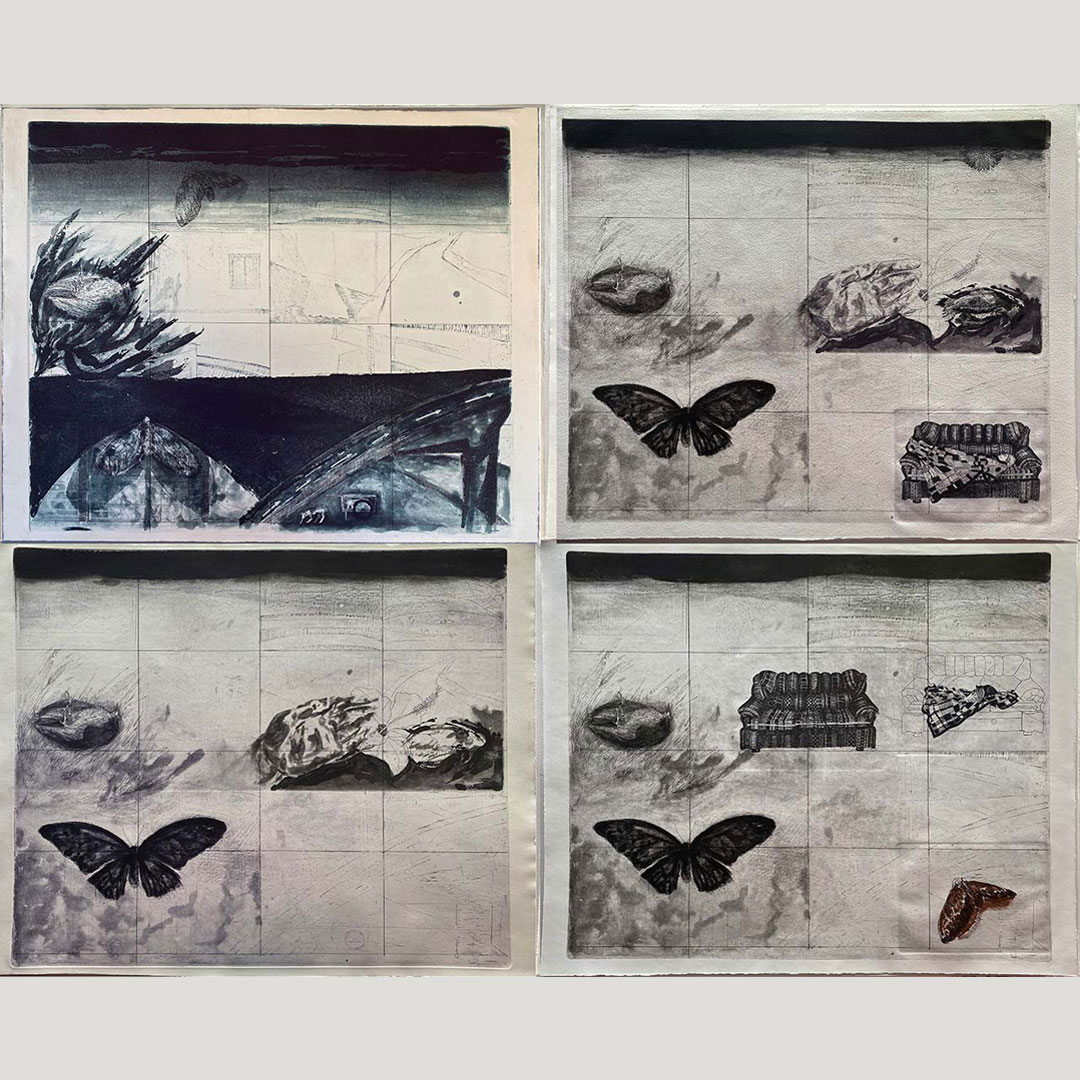
Impress/artist`s book (etching, woodcut, silkscreen and painting on paper) ; // 55,0 x 65,0 cm (closed); 55,0 x 130,0 cm (closed); 20 sheets. Notebook. Book. Diary. Memory that constantly edits information/remembrance. To draw to create and to tell stories through colours and shapes. To represent the world that I inhabit. To add and/or take out details is a way to propose detours on the path as a pretext to discover new possibilities for organizing the narrative. The alterations in the landscapes, through colour, adding or subtracting elements, are resources to propose an attentive and investigative look at the transience and unfolding of time that acts on the environments, objects and landscapes. The images can be presented and rearranged in infinite ways: as the seven musical notes and/or the letters in the alphabet. It is like a combinatorial game. With each round, it is possible to change everything and keep ongoing.
horizon, still and through
Monica Chan


Paraffin and beeswax on wood - 35,5 x 94,5 x 2,5 cm “Horizon, still and through” is part of a series of works around an image that repeats itself: landscapes where peaks, reliefs, and horizons are drawn. Using wax and paraffin, melted and poured over a support, the images that appear suggest mountain formations, with irregular layers and accumulations of matter. Marks of the time and use, stains and scratches, on the surface of the wood, translate as if the sky, the atmosphere in such a landscape. The draws of peaks and slopes, overlapping each other, in layers, in a wide and crooked horizon, emerge from a memory created by the experience of a trip that has happened a long time ago, and that since that unfolds in new glimpses. The immensity persists, traversed in the gaze.
Landing on reverie
Monica Chan
Paraffin and beeswax on wood - 42 x 88 x 3 cm From the association two itches, appears this work, specially made for the exhibition Aurora Imprevisível. "Landing on reverie" combines the impression of the landscape that continually comes to memory and the affection by ordinary and worn out objects. Fragments of two different pieces of furniture are merged, forming a third object that sorts of frame the view to mountains and valleys. Wax and paraffin fill gaps and cracks, interspacing layers with different degrees of translucency, opacity and density. From the bottom layers, running from one top to the other, the gaze rises, stretches and crosses the jagged mountains, sails to the other side and, from there, comes back by another way. Crossing the strait, vastness happens.